

- Author: Vladislav A. Yastrebov
- Afffiliation: CNRS, MINES Paris - PSL
- License: BSD 3-Clause License
- Date: April 26-30, 2024
- Note: The code is provided as is and the author is not responsible for any damage caused by the code.
- AI usage: GPT4 and copilot were used to co-construct the code.
This is a code that converts grayscale image a set of particles using repulsion/attraction algorithm (electrostatic interaction).
Positively charged particles with the charge proportional to the normalized darkness Mesh = True.
Code based on the particle Electrostatic halftoning [1], but essentially on the details provided on the associated web-page [2] with some modifications concerning the gradient descent and the mesh generation.
Version 2 (current one) apart from fast convergence and better control over the particles' distribution, ensures a more accurate follow-up of the image's features.
-
[1] Schmaltz, C., Gwosdek, P., Bruhn, A. and Weickert, J., 2010, December. Electrostatic halftoning. In Computer Graphics Forum (Vol. 29, No. 8, pp. 2313-2327). Oxford, UK: Blackwell Publishing Ltd. doi
-
[2] Web-page: www.mia.uni-saarland.de/Research/Electrostatic_Halftoning/index.shtml
- Python 3.7 or higher
- Numba
- Numpy
- Matplotlib
- PIL
- Scipy
- ffmpeg [optional] for frame to video conversion if needed.
The code can be run from the command line as follows:
python Particles_repulsion.py image_name.pngwhere image_name.png is the path to the image file.
All parameters are set in the code itself.
    cutoff = 20             # Cutoff distance for electrostatic forces
    force_factor = 0.5      # Factor making a link between displacement increment and the acting force
    total_frames = 20       # Number of computed frames/iterations to stabilize the particles
    particle_size = 1.25    # Size of the particles in the output image
    DPI = 400               # Resolution of the output image
    eps_regulation = 0.1    # Regularization parameter to prevent division by zero in force calculation (in pixel size)
    Mesh = False            # If True, the mesh is generated
# *Extra parameters for v2*
    zero_probability_offset = 0. # Offset for the probability to have a particle at a given location; to keep white - white keep it zero, to add some particles at the purely white background this parameter represent the probability (between 0 and 1) to have a particle at white background.
The code will generate the following files:
log_TIMESTAMP.txt- log file with the information about the runimage_name_particle_frame_xx.png- images of the particles ifMesh = False, withxxbeing the frame number;image_name_particle_animation.mp4- video of the particles' motion ifMesh = False;image_name_mesh_frame_xx.png- images of the mesh ifMesh = True;image_name_mesh_animation.mp4- video of the mesh ifMesh = True.
For more control over the animation one can use Tools/Convert_frames_to_fmpeg.sh script to convert the frames to the video, it is based of ffmpeg tool.
- Original image

Original image from Look and Learn distributed under CC BY 4.0 by Joseph Barnard Davis and John Thurnam.
- Mesh: initial and final state (CC BY 4)


See animation of the mesh equilibration in Examples/Skull_II_v2/skull_mesh_2.mp4.
- Particles: initial and final state (CC BY 4)


See animation of particles' equilibration in Examples/Skull_II_v2/skull_particles_2.mp4.
- Original image

Original image CC but the authors was not identified.
- Mesh: initial and final state (CC BY 4)


- Particles: initial and final state (CC BY 4)


- Original image

- Mesh: initial and final state


- Particles: initial and final state


I keep them for their aesthetic value, but they are not representative of the current version of the code.


Original image from Look and Learn distributed under CC BY 4.0 by Joseph Barnard Davis and John Thurnam. Derivatives CC BY 4.0.


Original image by Tiffany, license is unknown, but broadly used in image analysis literature. Derivatives CC BY 4.0.
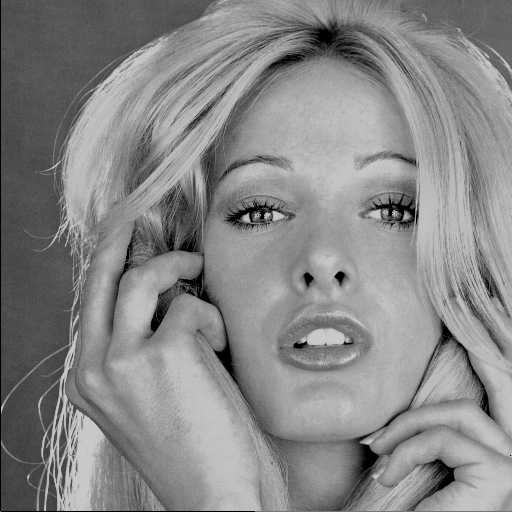


Original "Permission = Use of this 512x512 scan is "overlooked" and by implication permitted by Playboy. Alexander Sawchuk et al scanned the image and cropped it specifically for distribution for use by image compression researchers, and hold no copyright on it." Wikipedia. Derivatives CC BY 4.0


Original image CC but the author was not identified. Derivatives CC BY 4.0.