Radiance is an open-source GPU platform developed at UC Berkeley. It is designed to help researchers and developers build and evaluate full-stack heterogeneous GPU systems targeting AI and neural graphics workloads.
Radiance provides:
- A scalable integration platform for heterogeneous accelerators, with clear interfaces for decoupled orchestration and data delivery.
- A clean-slate SIMT core designed for modern, register-heavy GPU kernels and optimized for ASIC implementation.
- Chipyard-based SoC integration, enabling tight host-device coordination for memory system behavior and kernel execution.
Radiance is under active development. Please refer to the following resources for more information:
- Radiance GPU architecture
- Muon SIMT core and command processor architecture
- Neutrino orchestration unit architecture
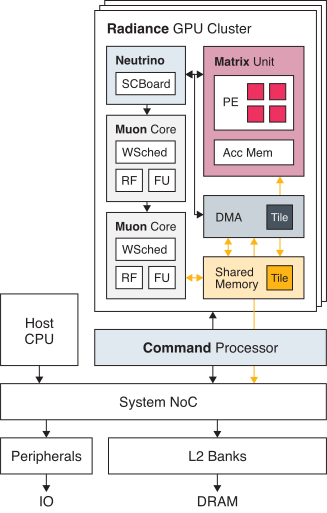
Muon, the SIMT core design for the Radiance GPU, is currently under active development.
See spec documents:
Run these commands in ${CHIPYARD_ROOT}/sims/vcs after source env.sh.
Use the graphics branch for Chipyard.
Full SoC config with multiple Muon clusters/cores, RTL memory subsystem and a host CPU core:
make CONFIG=RadianceTapeoutSimConfig run-binary LOADMEM=1 BINARY=...
Below simulates a GPU-standalone, core-isolated config, useful for functional verification and fast debugging iterations:
Single Muon core, with Cyclotron-based IMEM and GMEM memory models, with differential-testing enabled against Cyclotron:
make SUB_PROJECT=muon CONFIG=MuonCoreTestConfig run-binary BINARY=...
Single Muon core, with Cyclotron-based IMEM and GMEM memory models, with differential-testing disabled:
make SUB_PROJECT=muon CONFIG=MuonCoreNoDiffTestConfig run-binary BINARY=...