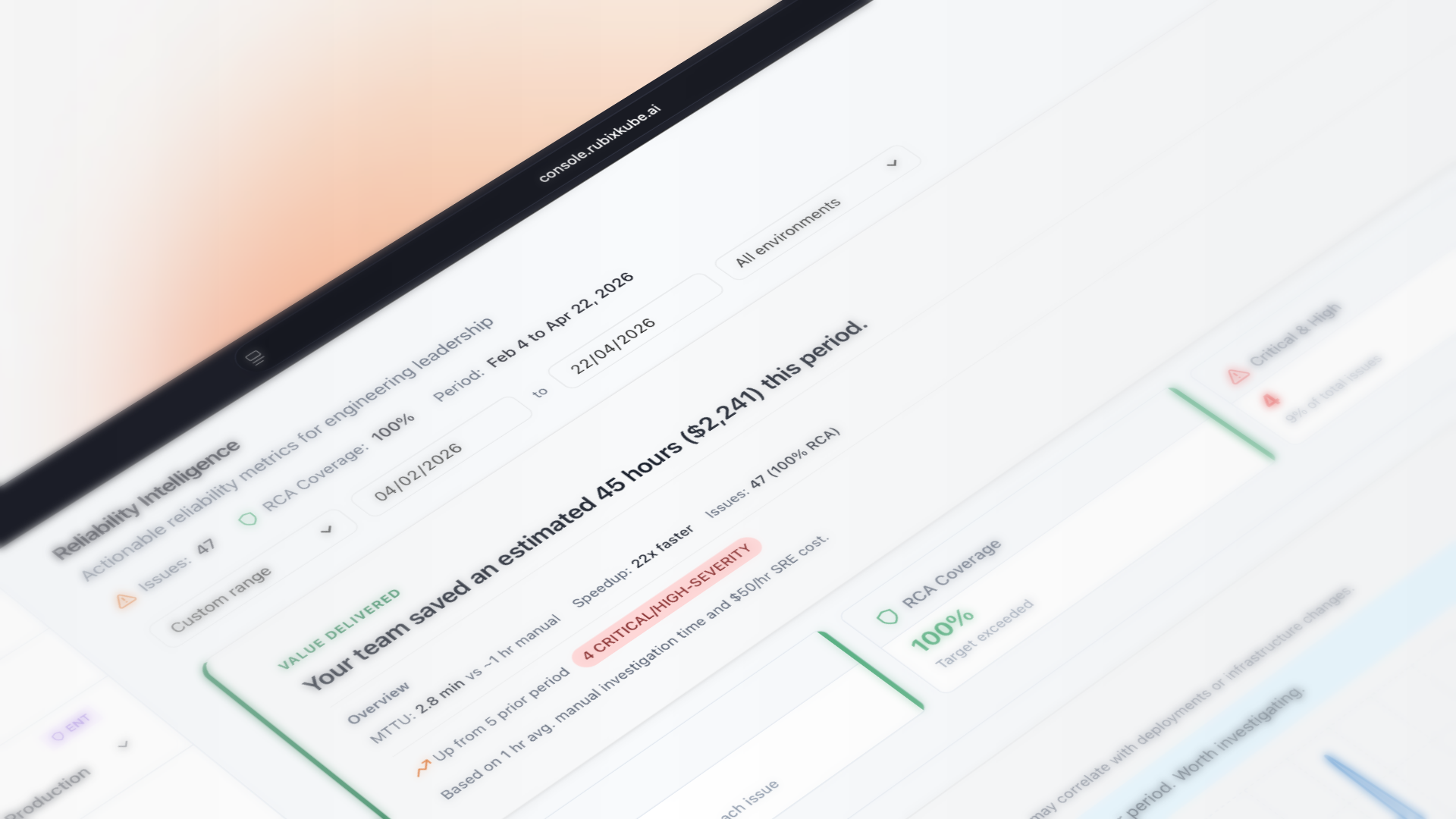
Beyond observability. Your infrastructure, healing itself.
This repository holds the public documentation for RubixKube, the Site Reliability Intelligence (SRI) platform. An AI-native system that detects anomalies, diagnoses root cause, and resolves failures across Kubernetes, AWS, GCP, Azure and Linux VMs. Most tools see your infrastructure for the first time, every time. RubixKube remembers.


Site Reliability Intelligence goes beyond observability. It closes the full loop: observe, plan, execute, learn. A system that compounds knowledge over time rather than starting from scratch on every incident.
- Autonomous remediation. Detect, diagnose and resolve failures without waking your team.
- Compounding memory. Every signal, session and resolution builds a deeper model of your system.
- Human-in-the-loop guardrails. Approvals and policy checks when you want them.
- Zero new tooling. Plugs into the stack you already run on day one.
Most tools treat every incident as a fresh start. RubixKube builds a persistent model of your infrastructure that deepens over time.
| Milestone | What RubixKube learns |
|---|---|
| Day 1 | Topology mapped. Every service, node and edge, automatically. |
| Week 1 | Dependencies understood. Upstream and downstream relationships known. |
| Month 1 | Causality emerging. Failure patterns surface before they fire. |
| Always | Yours, entirely. A model no other tool has, built only by being there. |
A coordinated Agent Mesh observes your environments through a lightweight, read-only Observer, plans and investigates through an SRI Agent, remembers through the Memory Engine and Knowledge Graph, produces evidence-linked root cause reports through the RCA Pipeline, and proposes fixes through the Remediation Agent, all behind a Guardian Agent that enforces policy. The whole thing runs a continuous OPEL loop so the platform gets sharper with every incident.
- Create your workspace. Sign up at console.rubixkube.ai. It takes under a minute. Grab your API key from the dashboard (it starts with
rk_). - Connect an environment. Pick your first target and follow the guide.
- Start a conversation. Open the dashboard and ask a question, or install the Rubix CLI and ask it from your terminal.
Environment guides:
Or start with the guided overview at Connect your environment.
| Section | What you will find |
|---|---|
| Getting Started | Welcome, quickstart, connect your environment. |
| Core Concepts | How RubixKube works, OPEL loop, Observer, Memory Engine, Knowledge Graph, Agent Mesh, Skills, Insights, RCA, Actions, Environments, Guardrails. |
| Environments | Kubernetes, AWS, GCP, Azure, Linux VMs. |
| Platform Capabilities | Dashboard, Rubix Chat Agent, Insights, Actions, RCA Reports, Analytics, Infrastructure, Integrations, Skills, Notifications, Workspace, Agent Skills Store. |
| Integrations | GitHub, GitLab, Slack, Teams, PagerDuty, Linear, Notion, Datadog, New Relic, Dynatrace, Prometheus, Grafana, Sentry, plus custom MCP and REST. |
| Tutorials | Monitor health, automate remediation, talk to your infra, add custom skills and integrations. |
| Rubix CLI | Install, configure, commands, examples. |
| Support | Troubleshooting, FAQ, system status, glossary. |
This site is built with Mintlify.
- Node.js 18 or higher
- npm or yarn
# Install the Mintlify CLI
npm i -g mint

# From the repo root
mint dev

# Preview at http://localhost:3000- Write in MDX. Markdown plus the Mintlify components.
- Lead with the answer. Use question-shaped headings when it helps AEO and GEO.
- Short sentences. Plain language. No em dashes.
- Verify every link and code example before opening a PR.
- Keep images under
/images/and use descriptive filenames.
See the full Contributing Guide for the workflow.
Contributions are welcome.
- Typos and small fixes. Open a PR directly.
- Larger changes. File an issue first using the issue templates so we can align on scope.
- Platform bugs. Report at rubixkube-io/rubixkube with steps to reproduce and environment details.
- Feature requests. Start a thread in Discussions.
Community guidelines:
- Website. rubixkube.ai
- Documentation. docs.rubixkube.ai
- Console. console.rubixkube.ai
- System status. rubixkube.ai/status
- Blog. rubixkube.ai/blog
- GitHub. github.com/rubixkube-io
- LinkedIn. linkedin.com/company/rubixkube
- X. @RubixKubeHQ
The documentation in this repository is released under the MIT License. The RubixKube platform has its own terms of service.
RubixKube. Site Reliability Intelligence.
connect@rubixkube.ai • Bengaluru, India