
Stratified molecular dataset splitting for QSAR model development.


When you build a QSAR model, the way you split your dataset determines how honestly you evaluate it.
A standard random train_test_split gives you a test set that happens to look like the training set — because it was drawn from the same distribution. This inflates your metrics. You think your model generalises to diverse chemical space. It doesn't.
Full dataset     →  logP range: -2 to 7,  MW range: 150–700
Random test set  →  logP range: -1.8 to 6.9,  MW range: 160–690  ← almost identical
The test set is not a real challenge. It's a mirror.
stratosampler fixes this by stratifying across multiple molecular properties simultaneously, so train and test sets each represent the full property distribution of your dataset — not a random slice of it.
Stratified test set  →  logP range: -1.9 to 6.8,  MW range: 155–685  ← intentionally representative
KS statistic (logP): 0.04 vs 0.18 for random split
pip install stratosampler
# with RDKit (required for computing properties from SMILES):
pip install "stratosampler[rdkit]"from stratosampler import PropertyStratifiedSplitter
splitter = PropertyStratifiedSplitter(
properties=["MolLogP", "MolWt", "TPSA"],
n_bins=5,
test_size=0.2,
random_state=42,
)
# From SMILES (computes properties automatically)
train_idx, test_idx = splitter.split(df, smiles_col="SMILES")
# From pre-computed property columns
train_idx, test_idx = splitter.split(df, property_cols=["logP", "MW", "TPSA"])
# Three-way split
train_idx, val_idx, test_idx = splitter.split(
df, smiles_col="SMILES"
) # set val_size > 0 in constructor
# Get DataFrames directly
train_df, test_df = splitter.get_split_dataframes(df, smiles_col="SMILES")Prevents analogue leakage by keeping molecules sharing a Murcko scaffold together in the same split, while still preserving property distributions at the scaffold-cluster level.
splitter = PropertyStratifiedSplitter(
    properties=["MolLogP", "MolWt", "TPSA"],
    test_size=0.2,
    scaffold_aware=True,
    random_state=42,
)
train_idx, test_idx = splitter.split(df, smiles_col="SMILES")from stratosampler import split_summary, plot_property_distributions
summary = split_summary(df, train_idx, test_idx, property_cols=["logP", "MW", "TPSA"])
print(f"Mean KS statistic: {summary['mean_ks_stat']:.3f}") # lower = better
print(f"Mean JS divergence: {summary['mean_js_div']:.3f}") # lower = better
print(f"Stratum coverage: {summary['coverage_score']:.3f}") # 1.0 = all strata in both splits
# Visualise distributions
fig = plot_property_distributions(df, train_idx, test_idx, ["logP", "MW", "TPSA"])
fig.savefig("split_distributions.png", dpi=150, bbox_inches="tight")from stratosampler import PropertyStratifiedSplitter, split_summary, plot_split_comparison
import numpy as np
props = ["MolLogP", "MolWt", "TPSA"]
# Random split
rng = np.random.default_rng(42)
idx = np.arange(len(df)); rng.shuffle(idx)
n_test = int(0.2 * len(df))
random_results = split_summary(df, idx[n_test:], idx[:n_test], props)
# Stratified split
strat = PropertyStratifiedSplitter(test_size=0.2, random_state=42)
train, test = strat.split(df, smiles_col="SMILES")
strat_results = split_summary(df, train, test, props)
# Scaffold-aware split
sc_strat = PropertyStratifiedSplitter(test_size=0.2, scaffold_aware=True, random_state=42)
sc_train, sc_test = sc_strat.split(df, smiles_col="SMILES")
sc_results = split_summary(df, sc_train, sc_test, props)
fig = plot_split_comparison(
{"random": random_results, "stratified": strat_results, "scaffold+strat": sc_results},
props,
metric="ks_stat",
)
fig.savefig("strategy_comparison.png", dpi=150, bbox_inches="tight")When passing properties to the splitter, these names are computed automatically from SMILES:
| Name | Description |
|---|---|
MolLogP |
Wildman-Crippen LogP |
MolWt |
Molecular weight |
TPSA |
Topological polar surface area |
NumHDonors |
H-bond donors |
NumHAcceptors |
H-bond acceptors |
NumRotBonds |
Rotatable bonds |
NumRings |
Total ring count |
NumAromaticRings |
Aromatic ring count |
FractionCSP3 |
Fraction of sp3 carbons |
NumHeavyAtoms |
Heavy atom count |
Any valid rdkit.Chem.Descriptors attribute name also works.
A well-stratified split catches real model failures:
- A model trained on a random split of a logP-skewed dataset will look good on paper but fail on low-logP compounds in deployment.
- A model evaluated on a scaffold-split-only test set may miss property distribution shift — your test compounds are structurally novel but chemically similar.
- Coverage score tells you whether your test set actually challenges the model across the full property space.
The goal is not to make your model look worse — it's to catch problems before they reach the project team.
The examples/chembl_egfr_stratified_sampling.py script fetches 362 EGFR IC50
records from ChEMBL, clusters them into chemical series via Murcko scaffold
analysis, then draws a stratified sample across every (series × pIC50 range)
stratum — guaranteeing at least 5 representatives per series.
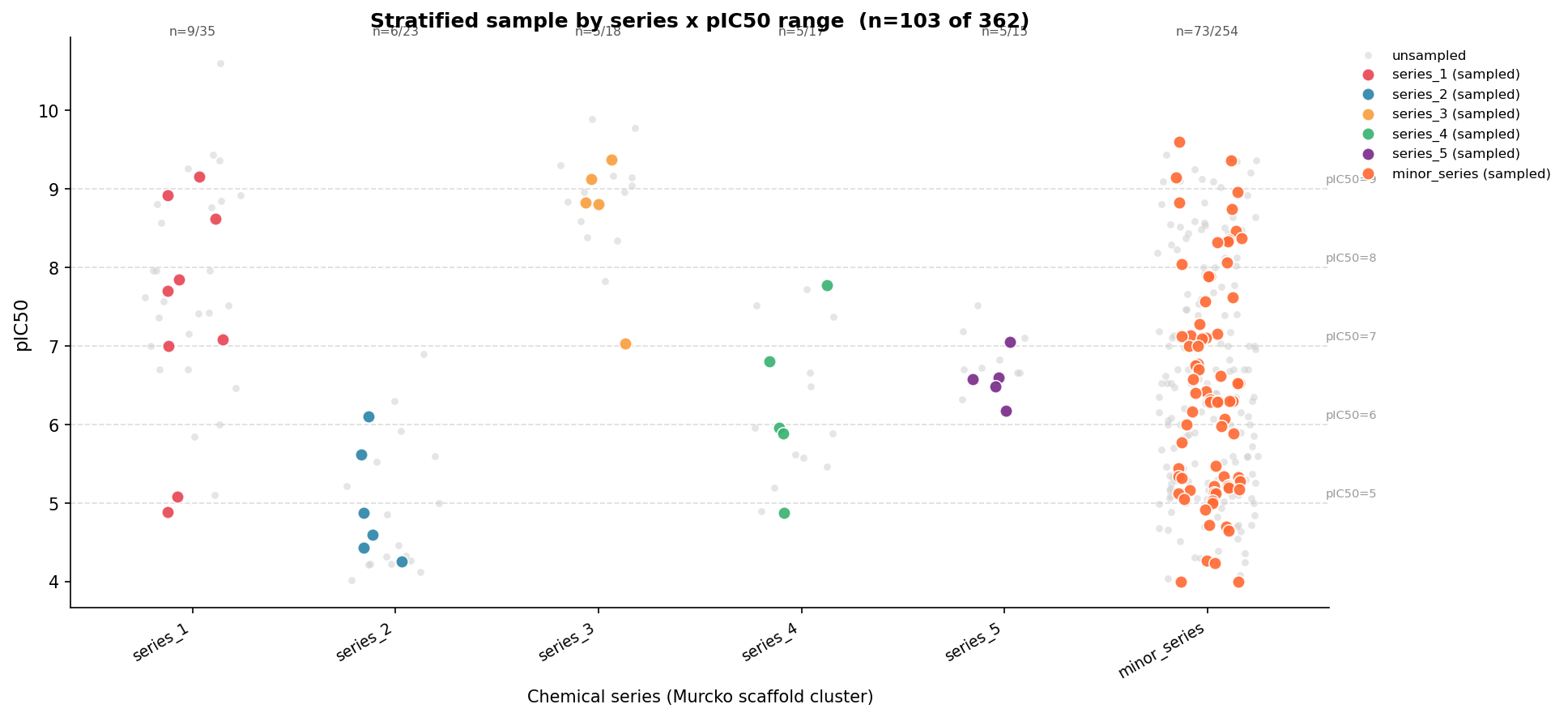
Grey dots are the full population; coloured circles are the 103 sampled compounds (28.5%), one colour per scaffold series. Dashed lines mark pIC50 activity-range boundaries. The sample achieves KS = 0.064 on the pIC50 distribution — close to what a pure property-stratified split would give, while also guaranteeing chemical-series coverage.
Issues and PRs welcome. Run the test suite with:
pip install -e ".[dev]"
pytest tests/ -vMIT. See LICENSE.
If stratosampler is useful in your research:
Fino, R. (2026). stratosampler: Stratified molecular dataset splitting for QSAR.
GitHub: https://github.com/rubbs14/stratosampler