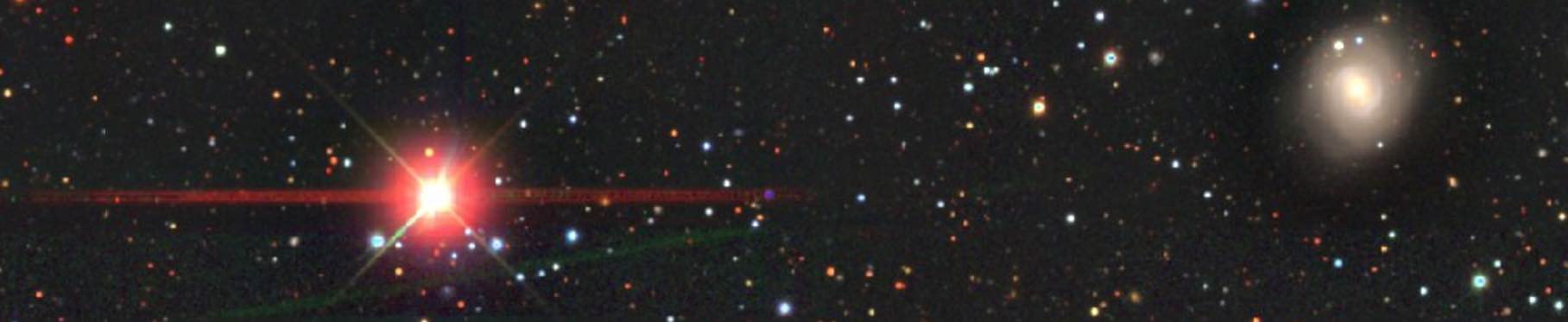




BLISS is a Bayesian method for deblending and cataloging light sources. BLISS provides:
- Accurate estimation of parameters in crowded fields with overlapping sources
- Calibrated uncertainties through fully Bayesian inference via neural posterior estimation (NPE)
- Scalability to petabyte-scale surveys containing billions of celestial objects
BLISS uses neural posterior estimation (NPE), a form of simulation-based inference in which a neural network maps telescope images directly to an approximate Bayesian posterior. BLISS uses autoregressive tiling with checkerboard patterns that align the variational distribution's conditional dependencies with the true posterior, improving calibration. BLISS systematically outperforms standard survey pipelines for light source detection, flux measurement, star/galaxy classification, and galaxy shape measurement.
Requirements: Python 3.12 or higher
BLISS is pip installable with the following command:
pip install bliss-toolkitThe required dependencies are listed in the [project] block of the pyproject.toml file.
- Install uv:
curl -LsSf https://astral.sh/uv/install.sh | sh- Install the fftw library (which is used by
galsim). With Ubuntu you can install it by running
sudo apt-get install libfftw3-dev- Install git-lfs if you haven't already installed it for another project:
git-lfs install- Now download the bliss repo and fetch some pre-trained models and test data from git-lfs:
git clone git@github.com:prob-ml/bliss.git- To create a virtual environment with the
blissdependencies satisfied, run
cd bliss
uv sync --all-extras- Activate the virtual environment:
source .venv/bin/activate- Verify that bliss is installed correctly by running the tests both on your CPU (default) and on your GPU:
pytest
pytest --gpu- Finally, if you are planning to contribute code to this repository, consider installing our pre-commit hooks so that your code commits will be checked locally for compliance with our coding conventions:
pre-commit installBLISS provides a command-line interface powered by Hydra for configuration management. The basic usage pattern is:
bliss mode={generate,train,predict} [config options]mode=generate- Generate synthetic training data from the forward modelmode=train- Train encoder networks on simulated or real datamode=predict- Run inference on astronomical images to produce catalogs
Configuration files are located in bliss/conf/ and can be composed and overridden via command line arguments.
The case_studies/ directory contains research applications of BLISS:
- weak_lensing/ - Tomographic shear (γ) and convergence (κ) mapping
- redshift/ - Photo-z estimation (BLISS-PZ) with multiple variational families
- galaxy_clustering/ - Galaxy cluster detection and membership prediction, validated on DES DR2
- dc2_cataloging/ - Full cataloging pipeline for DC2 simulation
- strong_lensing/ - Strong gravitational lens detection
- spatial_tiling/ - Spatially autoregressive tiling for astronomical cataloging
- psf_variation/ - Spatially varying PSFs for astronomical cataloging
Yicun Duan, Xinyue Li, Camille Avestruz, Jeffrey Regier, and LSST Dark Energy Collaboration. Neural posterior estimation for cataloging astronomical images from the Legacy Survey of Space and Time. arXiv:2510.15315. 2025.
Jeffrey Regier. Neural posterior estimation with autoregressive tiling for detecting objects in astronomical images. arXiv:2510.03074. 2025.
Aakash Patel, Tianqing Zhang, Camille Avestruz, Jeffrey Regier, and LSST Dark Energy Science Collaboration. Neural posterior estimation for cataloging astronomical images with spatially varying backgrounds and point spread functions. The Astronomical Journal. 2025.
Runjing Liu, Jon D. McAuliffe, Jeffrey Regier, and The LSST Dark Energy Science Collaboration. Variational inference for deblending crowded starfields. Journal of Machine Learning Research. 2023.
Mallory Wang, Ismael Mendoza, Cheng Wang, Camille Avestruz, and Jeffrey Regier. Statistical inference for coadded astronomical images. NeurIPS Workshop on Machine Learning and the Physical Sciences. 2022.
Yash Patel and Jeffrey Regier. Scalable Bayesian inference for detecting strong gravitational lensing systems. NeurIPS Workshop on Machine Learning and the Physical Sciences. 2022.
Derek Hansen, Ismael Mendoza, Runjing Liu, Ziteng Pang, Zhe Zhao, Camille Avestruz, and Jeffrey Regier. Scalable Bayesian inference for detection and deblending in astronomical images. ICML Workshop on Machine Learning for Astrophysics. 2022.