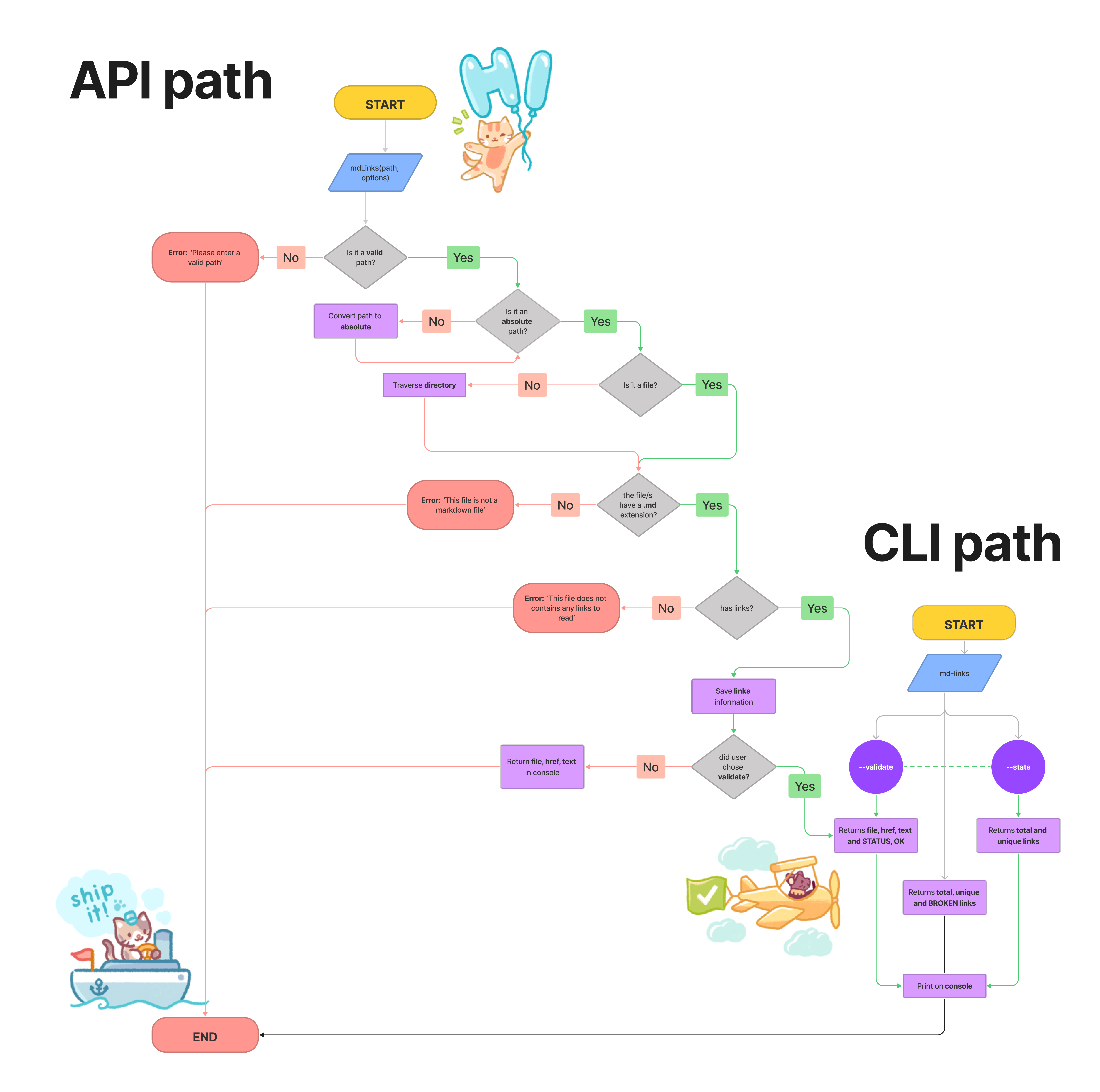
The heart of this project was to essentially build an npm package (and API) that you can use on your projects to know what links are in your markdown files, validate them and generate stats about them. This package can support files and directories.
Install the library with the command:
npm i https://github.com/pibmunoz/DEV001-md-links
For using this package as an API, you have to use require (CommonJS) the mdLinks(path, options) module after installing it, in whichever file that you want. This module has two arguments:
Note that this API is a pending promise, so you have to use .then and .catch after the module to resolve it.
- path, for the relative or absolute path where you need to enter the path of your file or directory.
- options, that is an object and you can choose between
default, false and truealternatives: the default (and false) behavior of this argument is to not validate the links that are present in the path and just return the href (URL found), text and file properties of each one, the true it is to validate the links and return the same properties as before plus status(HTTP request-response) and ok('fail' or 'ok' based on the previous property).
Opposite the API, this library on CLI just returns the value of the resolved (...or rejected 👀) promise.
If you just write on your cli md-links you will find a welcome greeting and with md-links --help the summary where you will see all of the commands that are supported by this package are:
md-links <path> returns only the links present on your path (file or directory).

md-links <path> --validate returns the links with the HTTP request-response.
Sometimes, links from LinkedIn or other pages will show as broken (or response 999), mainly because these sites do not allow direct access to the HTTP response.

md-links <path> --stats returns the stats (total and unique links) on your path.

md-links <path> --validate --stats returns the stats and validates (total, unique and broken links) on your path.