A toolkit for analyzing and visualizing attention mechanisms in transformer models applied to molecular data, providing insights into how models process chemical information and molecular representations.


- Interactive Artifacts
- Installation
- Dataset
- Model Architecture
- Training Pipeline
- Visualization Features
- Usage
- Results
- License
- Citation
- Acknowledgments
Install the required dependencies using pip:
pip install -r requirements.txtThis project utilizes the Open Molecules 2025 (OMol25) dataset, a collection of molecular structures and properties designed for machine learning applications in computational chemistry.
- Source: Hugging Face Dataset Repository
- Content: Chemical descriptions with associated molecular properties
The core model is built upon ChemBERTa-zinc-base-v1, a specialized transformer architecture optimized for chemical data processing:
- Input: Chemical descriptions with molecular properties
- Output: Language model trained for chemical property prediction and molecular representation learning
- Architecture: BERT-based transformer with domain-specific adaptations for molecular data
- Training Objective: Dual-purpose model for both property prediction and representation learning

Figure 1: Training pipeline showing data preprocessing, model architecture, and optimization steps.
This toolkit provides comprehensive visualization capabilities for understanding attention patterns in molecular transformer models.
UMAP Dimensionality Reduction: Interactive visualization of molecular embeddings in reduced dimensional space.

Figure 2: UMAP projection colored by number of atoms, revealing structural patterns in molecular space.

Figure 3: Sample molecule clusters formed in UMAP space, demonstrating learned chemical similarities.
Three-dimensional visualization combining attention patterns across all model layers and heads.

Figure 4: Combined attention patterns visualized in three dimensions, showing global attention flow patterns.
Regional Focus Patterns: Analysis of whether attention heads specialize in different regions of molecular sequences.

Figure 5: Parallel coordinates plot showing focus patterns across layers and heads.

Figure 6: Bar plots comparing attention distribution to beginning, middle, and end regions of molecular sequences.
Positional Attention Distribution: Detailed analysis of how attention is distributed across different positions in molecular formulas.

Figure 7: Multi-panel analysis showing:
- Heatmap of average attention weights by position and layer
- Variance plot highlighting positions with variable attention
- Entropy plot distinguishing focused vs. diffuse attention patterns
Individual Head Patterns: Comprehensive analysis of how different attention heads develop specialized functions.

Figure 8: Grid visualization of attention matrices for each layer-head combination.

Figure 9: 3D surface plots revealing attention patterns for selected specialized heads.
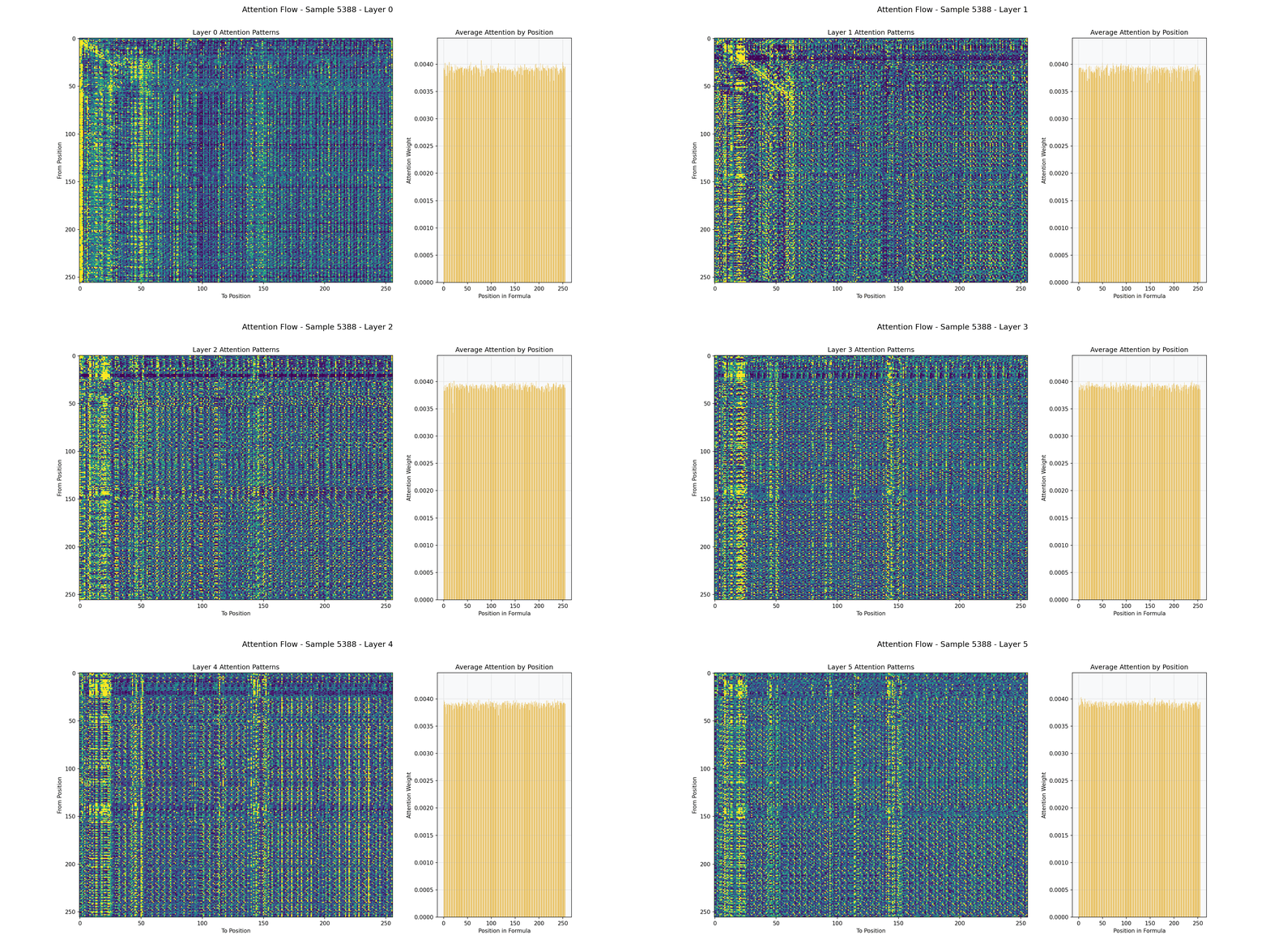
Attention Flow Animation: Interactive visualization showing relationships between molecular tokens and positions over time.

Figure 10: Dynamic attention flow animation revealing token-to-token attention relationships.
Attention River Plot: Flow visualization showing attention intensity evolution across model layers.

Figure 11: River plot visualization tracking attention flow intensity across transformer layers.
from attention_viz import CombinedAttentionVisualizer

visualizer = CombinedAttentionVisualizer("path/to/attention/maps")
visualizer.run_full_analysis(sample_id="5388") # or None for auto-detectionThe visualization toolkit provides several key insights into molecular attention patterns:
- Layer-specific Specialization: Different transformer layers focus on distinct aspects of molecular structure
- Position-dependent Attention: Systematic variations in attention based on token position within molecular sequences
- Head Specialization: Individual attention heads develop specialized functions for different chemical features
- Hierarchical Processing: Evidence of hierarchical information processing from local to global molecular features
This project is licensed under the MIT License.
If you use this toolkit in your research, please cite:
@software{molecular_attention_viz,
  title={Visualizing Attention Patterns in Molecular Data},
  author={[Nooshin Bahador]},
  year={2025},
  url={https://github.com/nbahador/attention-visualization-tool}
}- Facebook AI Research for the OMol25 dataset
- DeepChem community for ChemBERTa model architecture