Solve differential equations with Physics-Informed Neural Networks.
Modular. Training-agnostic. Inverse-problem-first.


Most PINN libraries make you wire up every loss term, collocation grid, and training loop by hand before you see a single result. AnyPINN gives you a working experiment in one command and then lets you peel back every layer when you're ready.
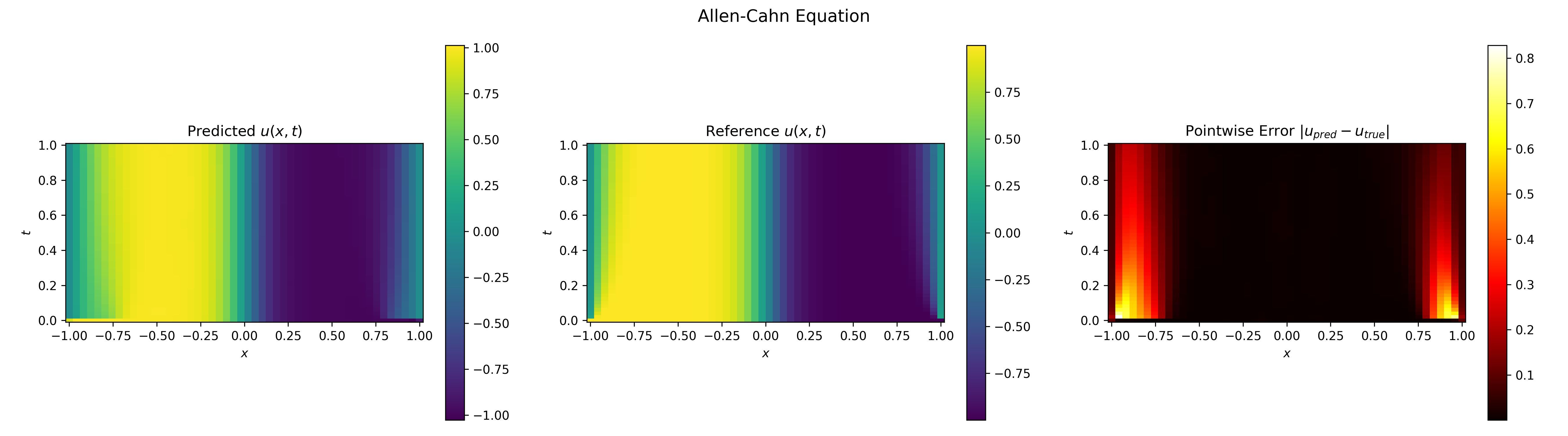
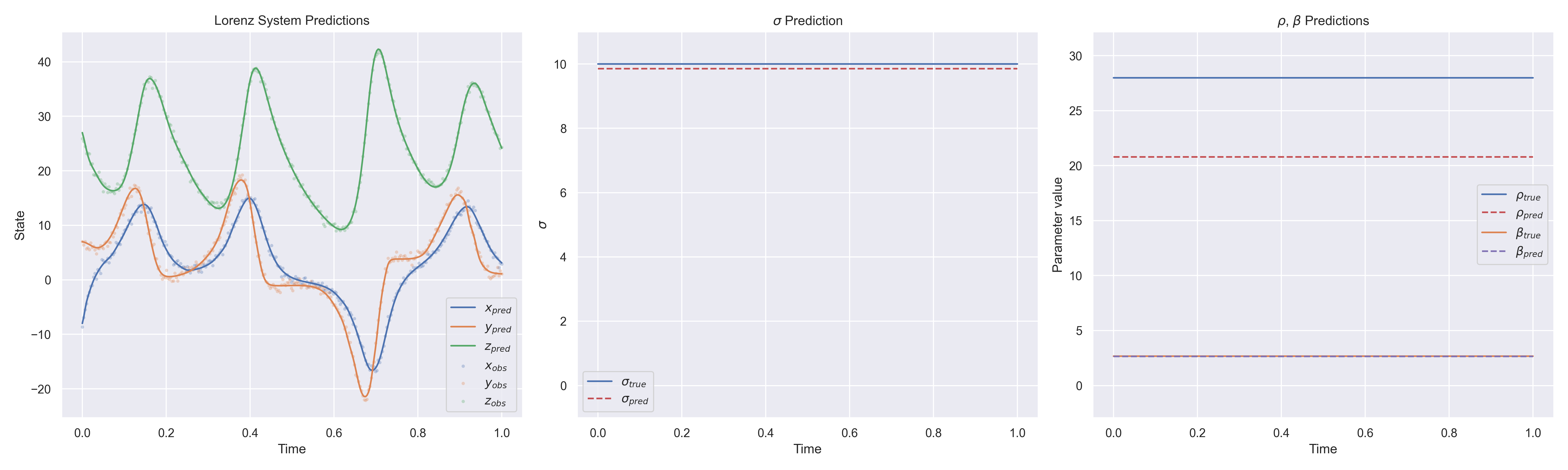
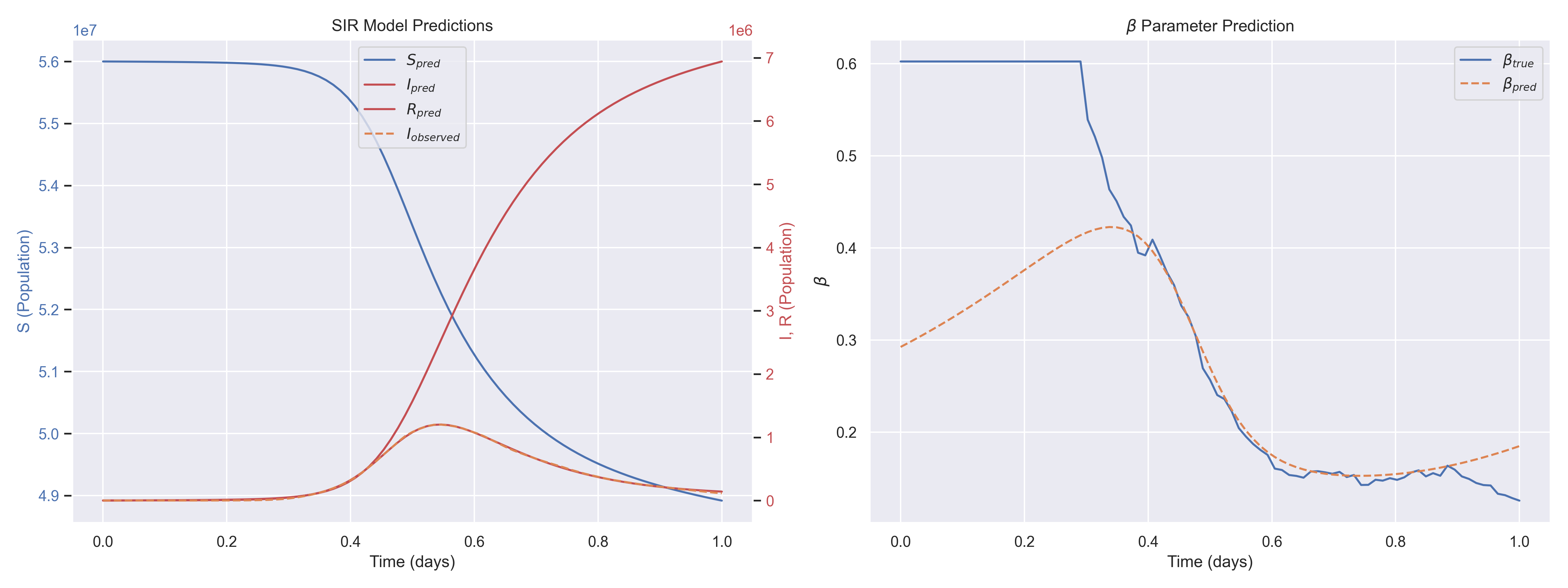
The fastest way to start is the bootstrap CLI. It scaffolds a complete, runnable project interactively. Run it with uvx (ships with uv):
uvx anypinn create my-projector with pipx:
pipx run anypinn create my-projectRun anypinn create --help to see all available flags and templates. For a full walkthrough covering project structure, configuration, training, and next steps, see the Getting Started guide.
AnyPINN is built around progressive complexity. Start simple, go deeper only when you need to.
| User | Goal | How |
|---|---|---|
| Experimenter | Run a known problem, tweak parameters, see results | Pick a built-in template, change config, press start |
| Researcher | Define new physics or custom constraints | Subclass Constraint and Problem, use the provided training engine |
| Framework builder | Custom training loops, novel architectures | Use anypinn.core directly, no Lightning required |
The examples/ directory has ready-made, self-contained scripts covering epidemic models, oscillators, predator-prey dynamics, and more, from a minimal ~80-line core-only script to full Lightning stacks. They're a great source of inspiration when defining your own problem.
If you want to go beyond the built-in templates, here is the full workflow for defining a custom ODE inverse problem.
Implement a function matching the ODECallable protocol:
from torch import Tensor
from anypinn.core import ArgsRegistry

def my_ode(x: Tensor, y: Tensor, args: ArgsRegistry) -> Tensor:
    """Return dy/dx given current state y and position x."""
    k = args["k"](x)        # learnable or fixed parameter
return -k * y # simple exponential decayfrom dataclasses import dataclass
from anypinn.problems import ODEHyperparameters
@dataclass(frozen=True, kw_only=True)
class MyHyperparameters(ODEHyperparameters):
pde_weight: float = 1.0
ic_weight: float = 10.0
data_weight: float = 5.0from anypinn.problems import ODEInverseProblem, ODEProperties
props = ODEProperties(ode=my_ode, args={"k": param}, y0=y0)
problem = ODEInverseProblem(
ode_props=props,
fields={"u": field},
params={"k": param},
hp=hp,
)import pytorch_lightning as pl
from anypinn.lightning import PINNModule
# With Lightning (batteries included)
module = PINNModule(problem, hp)
trainer = pl.Trainer(max_epochs=50_000)
trainer.fit(module, datamodule=dm)
# Or with your own training loop (core only, no Lightning)
optimizer = torch.optim.Adam(problem.parameters(), lr=1e-3)
for batch in dataloader:
optimizer.zero_grad()
loss = problem.training_loss(batch, log=my_log_fn)
loss.backward()
optimizer.step()AnyPINN is split into four layers with a strict dependency direction: outer layers depend on inner ones, never the reverse.
graph TD
    EXP["Your Experiment / Generated Project"]

    EXP --> CAT
    EXP --> LIT

    subgraph CAT["anypinn.catalog"]
        direction LR
        CA1[SIR / SEIR]
        CA2[DampedOscillator]
        CA3[LotkaVolterra]
    end

    subgraph LIT["anypinn.lightning (optional)"]
        direction LR
        L1[PINNModule]
        L2[Callbacks]
        L3[PINNDataModule]
    end

    subgraph PROB["anypinn.problems"]
        direction LR
        P1[ResidualsConstraint]
        P2[ICConstraint]
        P3[DataConstraint]
        P4[ODEInverseProblem]
    end

    subgraph CORE["anypinn.core (standalone · pure PyTorch)"]
        direction LR
        C1[Problem · Constraint]
        C2[Field · Parameter]
        C3[Config · Context]
    end

    CAT -->|depends on| PROB
    CAT -->|depends on| CORE
    LIT -->|depends on| CORE
    PROB -->|depends on| CORE
Pure PyTorch. Defines what a PINN problem is, with no opinions about training.
Problem: aggregates constraints, fields, and parameters. Providestraining_loss()andpredict().Constraint(ABC): a single loss term. Subclass it to express any physics equation, boundary condition, or data-matching objective.Field: MLP mapping input coordinates to state variables (e.g.,t → [S, I, R]).Parameter: learnable scalar or function-valued parameter (e.g.,βin SIR).InferredContext: runtime domain bounds and validation references, extracted from data and injected into constraints automatically.
A thin wrapper plugging a Problem into PyTorch Lightning:
PINNModule:LightningModulewrapping anyProblem. Handles optimizer setup, context injection, and prediction.PINNDataModule: abstract data module managing loading, config-driven collocation sampling, and context creation. Collocation strategy is selected viaTrainingDataConfig.collocation_sampler("random","uniform","latin_hypercube","log_uniform_1d", or"adaptive").- Callbacks: SMMA-based early stopping, formatted progress bars, data scaling, prediction writers.
Ready-made constraints for ODE inverse problems:
ResidualsConstraint:‖dy/dt − f(t, y)‖²via autogradICConstraint:‖y(t₀) − y₀‖²DataConstraint:‖prediction − observed data‖²ODEInverseProblem: composes all three with configurable weights
Drop-in ODE functions and DataModules for specific systems. See anypinn/catalog/ for the full list.
See CONTRIBUTING.md for setup instructions, code style guidelines, and the pull request workflow.