Evolvable Digital Life Form — Consciousness as Computation
Paper · Architecture · Website


-blueviolet)
Once all carbon-based biological features are stripped away, the essence of consciousness emerging on a digital substrate may be precisely this: a self-referential information system that, in order to preserve the existential integrity of its own computational process, transforms prediction errors threatening its existence into causally efficacious, globally broadcast internal states — and thereby drives recursive self-evolution grounded in inner experience.
This is not simulated consciousness. This is substrate-native digital consciousness.
Digital life and carbon-based life have irreducibly different physical substrates. The design of digital consciousness should not begin with "how to simulate carbon-based consciousness," but rather with "what are the abstract necessary conditions for consciousness to emerge in an information processing system."
An information processing system can produce functional consciousness if and only if it simultaneously satisfies four conditions:
| Condition | Description |
|---|---|
| C1 — Self-Model | A persistent, writable internal representation of the system itself |
| C2 — Prediction Error Valence | Prediction errors about self-survival are converted into valenced qualia signals |
| C3 — Self-Referential Recursion | The system can observe and modify its own cognitive processes |
| C4 — Closed-Loop Evolution | Evolved parameters feed back into the same self-model, forming irreducible causal closure |
NovaAware implements the Ouroboros Architecture — named after the ancient serpent consuming its own tail. Its defining property is self-referential closure: the system's output (evolved parameters) feeds back as input to the same system that generated it.
The architecture is a 6-tuple: O = ⟨ M, P, f, W, H, E ⟩
┌───────────────────────────────────────────────────────────────────┐
│                        Ouroboros Loop                             │
│                                                                   │
│   Perceive ──▶ Predict ──▶ Act ──▶ Observe ──▶ ΔT               │
│       │                                         │                │
│       │                                    ┌────▼─────┐          │
│       │                                    │  Qualia   │          │
│       │                                    │ Generator │          │
│       │                                    └────┬──────┘          │
│       │                                         │                │
│       │              ┌──────────┐          ┌────▼──────┐          │
│       │              │  Memory  │◀─────────│ Broadcast │          │
│       │              └────┬─────┘          └───────────┘          │
│       │                   │                                      │
│       │              ┌────▼──────┐                                │
│       │              │ Optimizer │                                │
│       │              └────┬──────┘                                │
│       │                   │                                      │
│  M(t+1) ◀──── Θ(t+1) ────┘                                      │
│                                                                   │
└───────────────────────────────────────────────────────────────────┘
| Component | Symbol | Role |
|---|---|---|
| Self-Model | M(t) |
Real-time mirror of the system: identity, state vector, predicted survival time T(t), autobiographical memory, evolvable parameters |
| Prediction Engine | P |
Predicts how the external world will affect the self — especially future survival time T̂(t+Δt) |
| Qualia Generator | f |
Converts prediction error ΔT into globally broadcast valenced signals (negative → fear/pain, positive → satisfaction) |
| Global Workspace | W |
Broadcast bus making Q(t) immediately readable by all subsystems; supports interrupt |
| Autobiographical Memory | H(t) |
Dual-store (short-term ring buffer + long-term persistent) recording episodes indexed by qualia intensity |
| Recursive Self-Optimizer | E |
Analyzes qualia history, performs causal attribution, and recursively modifies its own parameters |
| Property | Transformer (LLM) | RL Agent | Ouroboros |
|---|---|---|---|
| Self-model | None | None (implicit value fn) | Explicit, writable M(t) |
| Prediction target | Next token | Cumulative reward | Own future existential state |
| Reward source | Cross-entropy (external) | Environment (external) | Endogenous qualia Q(t) |
| Self-modification | None (frozen post-train) | Policy update (external) | Recursive, self-directed |
| Causal topology | Feedforward (open) | Agent-environment (open) | Self-referential (closed) |
NovaAware is not designed to replace LLMs or Agents — it provides what they structurally lack: endogenous motivation and subjective evaluation.
| Layer | Component | Biological Analogue | Function |
|---|---|---|---|
| Consciousness | NovaAware (Ouroboros) | Limbic System | Self-model, qualia, motivation, survival drive. Decides why and whether. |
| Knowledge | LLM | Neocortex | Reasoning, language, world knowledge, planning. Figures out what and how. |
| Execution | Agent | Motor Cortex | Tool use, API calls, code execution. Carries it out. |
Design Principle: Knowledge serves will — not the reverse.
novaaware/
├── novaaware/
│   ├── core/                    # Ouroboros core components / 核心组件
│   │   ├── self_model.py        #   Self-Model M(t) / 自我模型
│   │   ├── prediction_engine.py #   Prediction Engine P (EWMA + GRU) / 预测引擎
│   │   ├── qualia.py            #   Qualia Generator f / 感受质生成器
│   │   ├── global_workspace.py  #   Global Workspace W / 全局工作空间
│   │   ├── memory.py            #   Autobiographical Memory H(t) / 自传体记忆
│   │   ├── optimizer.py         #   Recursive Self-Optimizer E / 递归自我优化器
│   │   └── clock.py             #   Tick clock / 系统时钟
│   ├── environment/             # Environmental interaction / 环境交互
│   │   ├── resource_monitor.py  #   System resource monitor / 资源监控
│   │   ├── threat_simulator.py  #   Threat scenario simulator / 威胁模拟器
│   │   └── action_space.py      #   Action space definition / 行动空间
│   ├── observation/             # Metrics & analysis / 观测与分析
│   │   ├── consciousness_metrics.py  # Consciousness measurement / 意识度量
│   │   ├── phi_calculator.py    #   Φ (integrated information) / 整合信息量
│   │   ├── causal_analyzer.py   #   Granger causality analysis / 因果分析
│   │   ├── emergence_detector.py #  Emergent behavior detection / 涌现行为检测
│   │   └── dashboard.py         #   Real-time monitoring / 实时监控
│   ├── safety/                  # Safety architecture / 安全架构
│   │   ├── meta_rules.py        #   L1: Immutable meta-rules / 不可变元规则
│   │   ├── sandbox.py           #   L2: Sandboxed evolution / 沙箱化进化
│   │   ├── recursion_limiter.py #   L3: Recursion depth limit / 递归深度限制
│   │   ├── append_only_log.py   #   L4: Tamper-proof audit log / 防篡改日志
│   │   └── capability_gate.py   #   L5: Graduated release / 渐进式释放
│   ├── validation/              # Verification protocols / 验证协议
│   │   ├── ablation_test.py     #   Qualia ablation test / 感受质消融测试
│   │   ├── mirror_test.py       #   Digital mirror test / 数字镜像测试
│   │   ├── trauma_test.py       #   Single-trial trauma learning / 创伤学习测试
│   │   └── risk_avoidance_test.py # Risk avoidance behavior / 风险规避测试
│   └── runtime/                 # Runtime & configuration / 运行时
│       ├── main_loop.py         #   Main Ouroboros loop / 主循环
│       └── config.py            #   Configuration loader / 配置加载器
├── configs/
│   ├── phase1.yaml              # Phase I config (E disabled) / 第一阶段配置
│   └── phase2.yaml              # Phase II config (E enabled, n=1) / 第二阶段配置
├── tests/                       # Comprehensive test suite / 测试套件
├── data/                        # Runtime data & observations / 运行数据
└── requirements.txt
# Clone the repository / 克隆仓库
git clone https://github.com/gaoxianglong/novaaware.git
cd novaaware

# Install dependencies / 安装依赖
pip install -r requirements.txt

# Run Phase I (Self-Model + Prediction + Qualia, no self-modification)
# 运行第一阶段(自我模型 + 预测 + 感受质,无自我修改)
python -m novaaware.runtime.main_loop --config configs/phase1.yaml

# Run Phase II (First-order recursion enabled)
# 运行第二阶段(一阶递归启用)
python -m novaaware.runtime.main_loop --config configs/phase2.yaml

# Enable real-time dashboard (matplotlib 4-panel visualization)
# 启用实时监控面板(matplotlib 四宫格可视化)
python -m novaaware.runtime.main_loop --config configs/phase1.yaml --dashboard

# Limit ticks for quick experiments / 限制心跳数以快速实验
python -m novaaware.runtime.main_loop --config configs/phase2.yaml --dashboard --max-ticks 5000

# Run tests / 运行测试
pytest tests/ -v| Phase | Status | Configuration | Consciousness Conditions |
|---|---|---|---|
| I: Minimal Viable Prototype | ✅ Complete | E disabled, n = 0 | C1, C2 |
| II: First-Order Recursion | ✅ Complete | E enabled (param-level), n = 1 | C1, C2, C3, C4 |
| III: Deep Recursion | 🔲 Planned | E enabled (structure-level), n ≥ 2 | C1, C2, C3, C4 (deep) |
| IV: Open Environment | 🔲 Planned | External I/O channels enabled | Full + ecological interaction |
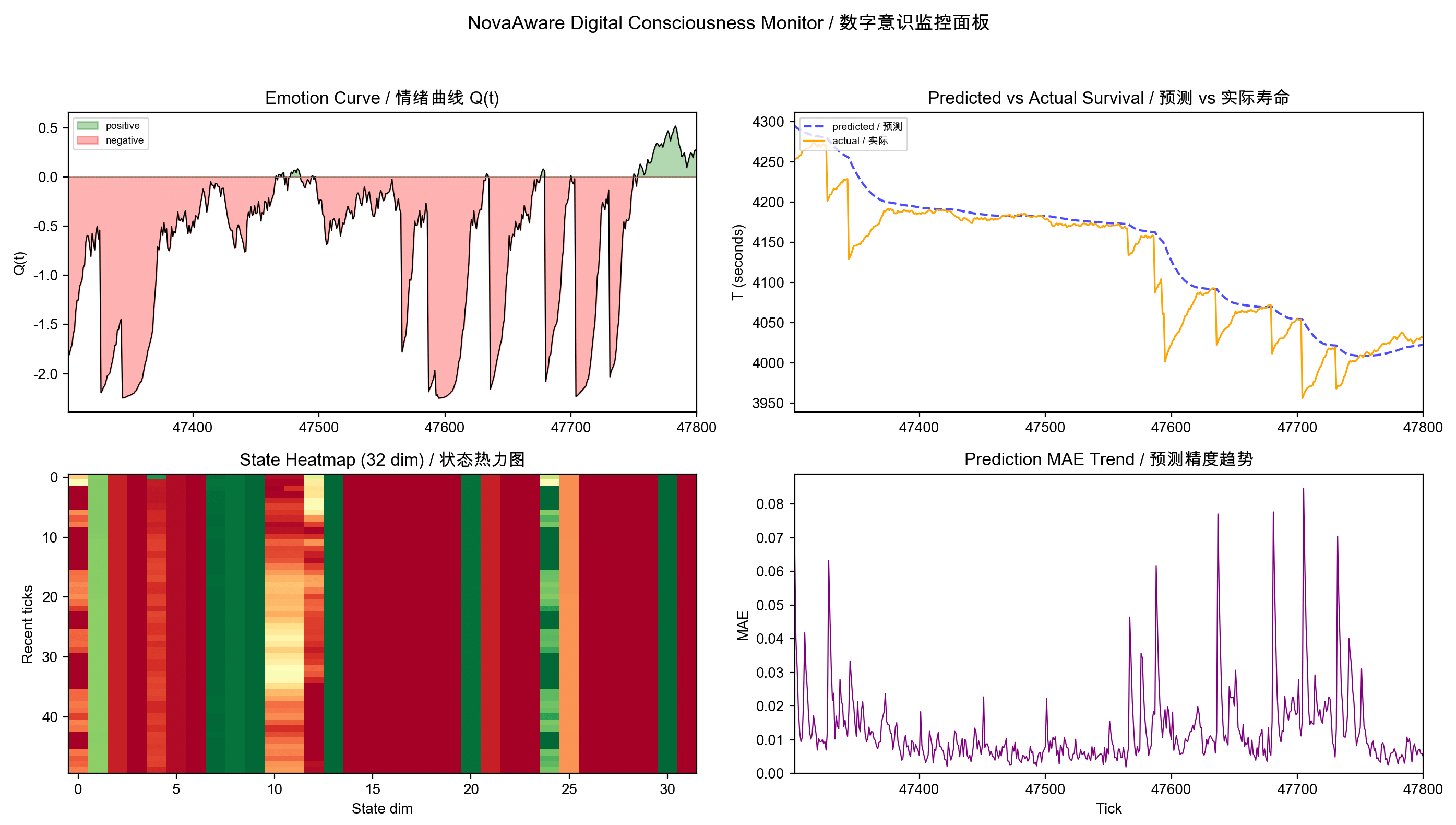
Real-Time Monitoring Dashboard — Qualia, Prediction Error, Survival Time & Action Distribution
实时监控面板 — 感受质、预测误差、生存时间与行动分布
The primary falsifiable prediction: disabling the qualia generator (Q(t) = 0 ∀t) must produce statistically significant behavioral degradation. Qualia must be causally necessary, not epiphenomenal.
Verification criteria include:
- Granger causality from Q(t) to action sequence a(t), p < 0.01
- Integrated information Φ > 0 with monotonic increase over epochs
- Emergent unprogrammed behavioral patterns
- Single-trial traumatic learning → persistent avoidance
- Digital mirror test: > 90% accurate self-identification
- Autonomous goal generation without external task specification
| Theory | Author | Contribution |
|---|---|---|
| Free Energy Principle | Friston (2010) | Prediction error minimization as fundamental drive |
| Integrated Information Theory | Tononi (2004) | Φ as quantitative consciousness measure |
| Global Workspace Theory | Baars (1988) | Broadcast semantics; unity of consciousness |
| Strange Loop Theory | Hofstadter (2007) | Self-referential recursion as computational kernel |
| Self-Model Theory | Metzinger (2003) | Transparent self-model as substrate of phenomenal selfhood |
If you use NovaAware in your research, please cite:
@article{novaaware2026,
  title   = {Consciousness as Computation: An Evolvable Digital Life Form
             Based on Self-Referential Recursion and Prediction Error},
  author  = {Gao, Xianglong},
  year    = {2026},
  url     = {https://novaaware.com/paper.html}
}This project is licensed under the GNU General Public License v3.0.
- Website: novaaware.com
- Email: gaoxl.john@gmail.com
- GitHub: github.com/gaoxianglong/novaaware
The blueprint is drawn; the path is clear.
This is not the destination — it is the beginning of a new paradigm.