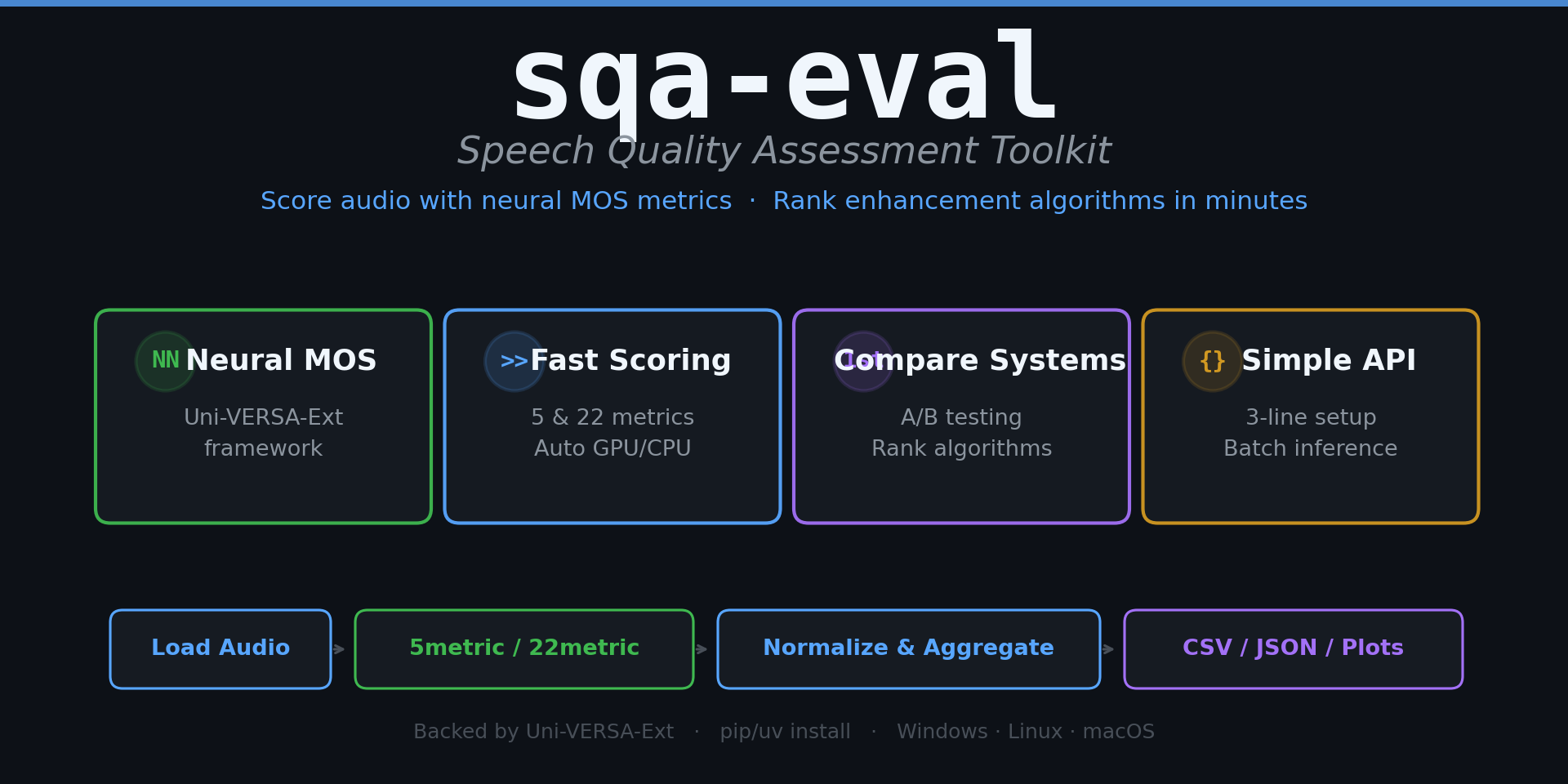
Speech Quality Assessment — score your audio with neural MOS metrics and rank enhancement algorithms in minutes, not days.
Backed by the Uni-VERSA-Ext framework.
📄 Paper · 🤗 Hugging Face Models
- GPU when available, CPU otherwise — auto-detected
- Cross-platform — Windows, Linux, macOS (via
uv)
For reliable and subjectively correlated scores, test files should meet the following guidelines:
- Duration — Uni-VERSA-Ext works best with short files (10–20 s). Longer files do not necessarily yield better results.
- Content — Files should contain continuous speech without prolonged silence gaps between speech sections. See the
assets/folder in the Uni-VERSA-Ext repository for examples. Following this guideline keeps the evaluation focused on speech quality and improves correlation with subjective ratings. Long silence gaps can mislead scores, especially for no-reference (non-intrusive) metrics. - Automatic preprocessing — Pass
--preprocessto automatically remove silence gaps via a Silero VAD before scoring. Speech segments are extracted, concatenated with 50ms noise guards (sampled from non-speech regions of the file), and capped at 1-minute chunks (scores are averaged across chunks). This is useful for long recordings with silence between utterances. See the CLI section below for usage. - Avoid — Extreme data augmentation can mislead the model and produce unreliable scores.
- Metric selection — Review the metric descriptions in the paper (Section II-B, particularly Table 1) and choose the metrics that best match your requirements. Give more weight to them in the evaluation. See Score Aggregation for more details.
git clone https://github.com/eCabral87/sqa-eval.git && cd sqa-eval

# One command, handles Python, virtualenv, and all deps:
uv sync --extra dev
That's it. You now have python, pytest, and the full inference stack ready to go.
Audio loading uses soundfile (bundles libsndfile for all platforms) — no system packages needed.
CPU (all platforms):
uv sync --extra devGPU (Linux/Windows with NVIDIA):
uv sync --extra dev --extra-index-url https://download.pytorch.org/whl/cu128from sqa_eval import Experiment
# --- Pit two denoisers against each other ---
#
# Directory layout expected:
# recordings/
# ├── dnn_v1/
# │ ├── sample01.wav
# │ └── sample02.wav
# └── dnn_v2/
# ├── sample01.wav
# └── sample02.wav
# clean_refs/
# ├── REF_sample01.wav (see Reference Convention below)
# └── REF_sample02.wav
#
exp = Experiment(
name="denoiser-shootout",
base_dir="./recordings", # parent dir containing one subdir per system
systems=["dnn_v1", "dnn_v2"], # system subdirectory names
ref_dir="./clean_refs", # clean references (REF_ prefix matched by stem)
model="22metric", # "5metric" | "22metric" | "both"
)
exp.run() # scores every file across all systems
exp.report() # CSV, JSON, and plots land in results/Every result gives you two aggregated scores:
common_score— weighted average of only the 5 no-reference MOS metrics (mos,dnsmos_ovrl,scoreq,utmos,nisqa_mos)extended_score— weighted average of all metrics the model produced
With "5metric" the two scores are identical (only those 5 metrics exist). With "22metric" they diverge because extended_score also includes SDR, PESQ, MCD, LSD, speaker similarity, etc.
Use "both" when your dataset mixes files with and without references. Files that have a matching reference are scored with "22metric" (all metrics), while files without a reference fall back to "5metric" (no-reference metrics only).
For a deeper dive into every function, implementation details, and more use cases see the Wiki.
You can also adapt test_smoke.py — it is a ready-to-run template you can edit with your own directories and model choice.
uv run test_smoke.pyOpen results/denoiser-shootout/ and you'll find:
results/denoiser-shootout/
├── scores.csv
├── summary.csv
├── ranking.csv
├── results.json
├── bar_common_score.png
├── box_common_score.png
├── radar.png
└── scatter_dnn_v1_vs_dnn_v2.png
from sqa_eval import Evaluator

# --- Score a single file ---
evaluator = Evaluator("5metric")      # 5 no-reference MOS metrics
result = evaluator.evaluate_file("sample.wav")
print(result.common_score) # → 0.72All evaluation functionality is also available from the command line. After uv sync, run:
# Show available commands
uv run sqa-eval --help

# Score a single file
uv run sqa-eval evaluate speech.wav --ref clean.wav --model 22metric

# Score a single file with VAD preprocessing (removes silence gaps)
uv run sqa-eval evaluate speech.wav --model 5metric --preprocess

# Score a directory
uv run sqa-eval evaluate-dir ./noisy --ref-dir ./clean --model 22metric --output-csv scores.csv

# Score a directory with preprocessing
uv run sqa-eval evaluate-dir ./noisy --model 5metric --preprocess --output-csv scores.csv

# Compare multiple systems (full report + plots)
uv run sqa-eval experiment denoiser-shootout ./recordings --systems dnn_v1,dnn_v2 --ref-dir ./clean_refs --model both

# Compare multiple systems with preprocessing (applied to no-reference scoring)
uv run sqa-eval experiment denoiser-shootout ./recordings --systems dnn_v1,dnn_v2 --model 5metric --preprocess
You can also use python -m sqa_eval instead of uv run sqa-eval.
The experiment command generates the same CSV, JSON, and plot outputs as the Python API.
| Alias | HF Repo | # Metrics | Needs Clean Ref? |
|---|---|---|---|
"5metric" |
vvwangvv/universa-ext_wavlm-base_5metric |
5 | No |
"22metric" |
vvwangvv/universa-ext_wavlm-base_22metric |
22 | Yes (for SDR, PESQ, MCD...) |
Or pass any HuggingFace repo ID directly: Evaluator("org/custom-model").
InferenceEngine auto-detects CUDA. If it's not available, a warning is printed once and inference falls back to CPU:
>>> from sqa_eval import InferenceEngine
>>> engine = InferenceEngine("5metric")
>>> engine.device
'cuda'   # or 'cpu' if no GPU
You can force CPU by unsetting the device variable before running:
CUDA_VISIBLE_DEVICES="" uv run python my_script.pyAfter the model produces raw metric scores (each on its own scale), the library normalises them into a single [0, 1] score:
- Normalise — each raw score
s_kis mapped to[0, 1]via min–max over its known range (e.g. MOS[1,5]→(s-1)/4; SDR[-30,30]→(s+30)/60) - Flip lower-is-better — metrics with
direction = -1(MCD, LSD) become1.0 - norm_valso 1.0 is always best - Weighted average — the final score is a weighted average, not a sum:
score = ( Σ w_k × norm_val_k ) / Σ w_k
Dividing by the total weight keeps the result in [0, 1] regardless of how many metrics contributed or what weights are set, making scores comparable across experiments. This combined score works similarly to the PRISM score proposed in this paper.
Weights: each metric has a default weight of 1.0, but you can pass custom per-metric weights to Evaluator(model, weights={"sdr": 2.0, "mos": 0.5}).
from sqa_eval import Evaluator

e = Evaluator(model="22metric")

result = e.evaluate_file("noisy.wav")                       # single file
results = e.evaluate_directory("./speech/", ref_dir="./refs/")  # whole folder

e.to_csv(results, "scores.csv")
e.to_json(results, "results.json")

# With VAD preprocessing (removes silence gaps before scoring)
e2 = Evaluator(model="5metric", preprocess=True)
result = e2.evaluate_file("long_recording.wav")from sqa_eval import Experiment
exp = Experiment(
name="my-comparison",
base_dir="./outputs", # contains dnn_v1/, dnn_v2/ subdirs
systems=["dnn_v1", "dnn_v2"],
ref_dir="./clean", # REF_file1.wav, REF_file2.wav, ...
model="both", # "5metric" | "22metric" | "both"
)
exp.run() # prints progress: "Scored 42/50 files in dnn_v1..."
exp.report() # dumps everything into results/my-comparison/from sqa_eval import InferenceEngine
engine = InferenceEngine("5metric")
scores = engine.predict("audio.wav") # → {mos: 3.2, ...}
# With reference (22metric)
scores = engine.predict("degraded.wav", ref_path="clean.wav")
# Batch
pairs = [("a.wav", None), ("b.wav", "ref_b.wav")]
all_scores = engine.predict_batch(pairs) # → [{mos: 3.2, ...}, {mos: 3.5, sdr: 12.1, ...}]
# Each result dict contains only the metrics the model computed for that pair.
# If a model requires a reference (e.g. "22metric") but ref_path is None,
# predict_batch raises ValueError — it does not silently produce garbage.src/sqa_eval/
├── __init__.py # public API
├── __main__.py # python -m sqa_eval entry point
├── cli.py # sqa-eval CLI (evaluate, evaluate-dir, experiment)
├── metrics.py # MetricDef, METRICS_5, METRICS_22
├── engine.py # InferenceEngine (wraps Uni-VERSA-Ext)
├── aggregator.py # ScoreAggregator + system ranking
├── io.py # scan_audio, match_references, resolve_experiment
├── preprocess.py # Silero VAD-based speech extraction (--preprocess)
├── reporter.py # CSV / JSON / summary table exports
├── plotter.py # bar, box, scatter, radar charts
└── experiment.py # Evaluator + Experiment high-level API
uv run ruff format src/ tests/    # formatter (black-compatible, just faster)
uv run ruff check src/ tests/     # linter
uv run pytest tests/ -v           # 74 unit tests, no GPU needed
Or do it all in one go:
uv run ruff format src/ tests/ && uv run ruff check src/ tests/ && uv run pytest tests/ -qTests mock the framework — no downloads, no GPU, no internet required.
Full-stack tests that load the real model from HuggingFace and run inference on synthetic audio (generated on the fly):
uv run pytest tests/ -m integration -vThese require network access, a GPU (falls back to CPU), and may take several minutes.
Put clean reference files in a ref_dir with the prefix REF_:
clean_refs/
├── REF_sample01.wav
└── REF_sample02.wav

outputs/dnn_v1/
├── sample01.wav   → paired with REF_sample01.wav
└── sample02.wav   → paired with REF_sample02.wav
Files without a matching reference are scored with no-ref metrics only.