Loop clicks, repetition, and dialogue masking are common issues in real-time game audio systems.
This guide explains the engineering principles behind stable, seamless ambience loops.
🎧 Test an Engine-Ready Ambience Loop
Download a seamless loop sample and test it directly in your engine:
▶ Click image to watch loop test (30s)
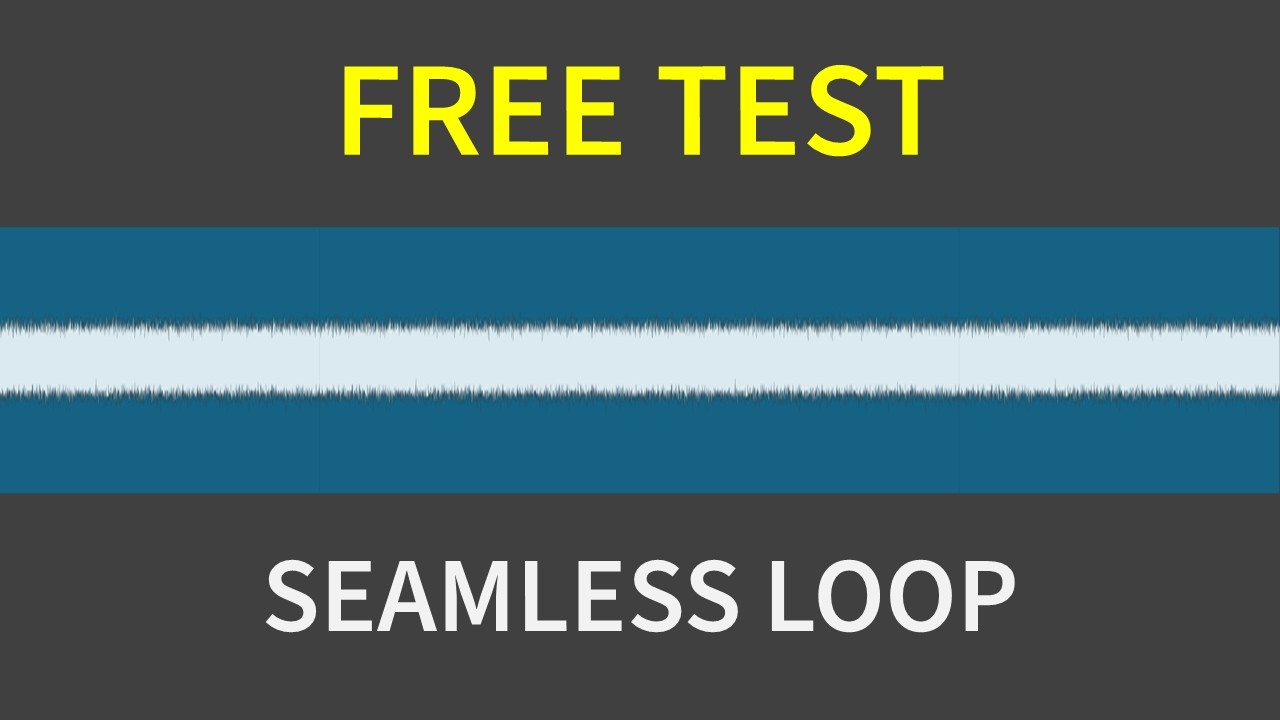
➡️ Direct WAV download (Deep Tension 30s)
https://raw.githubusercontent.com/chemitree/game-audio-ambience-engineering-guide/main/samples/deep_tension_normal_engine_ready_30s.wav
➡️ Full evaluation pack (multiple samples) https://chemitree.gumroad.com/l/vjzbux
Seamless Loop Boundary Example of a seamless loop boundary with no discontinuity
 Example of a seamless loop boundary with no discontinuity
The goal of this guide is to explain common technical issues in ambience loop design and provide practical insights for creating stable ambience in real-time audio systems.
This guide focuses on engineering principles rather than specific audio tools or plugins.
 Stable amplitude profile suitable for long-duration playback
- Unity
- Unreal Engine
- FMOD
- Wwise
 Representative spectral profile of ambience signal
This guide covers common technical problems encountered when designing ambience loops for game audio systems.
The articles focus on common runtime problems such as:
-
loop discontinuity
-
spectral masking
-
repetition perception
-
runtime loop stability
A QC pipeline can be used to validate ambience loops in real-time audio environments.
Validation includes:
• Loop seam analysis (RMS / peak continuity across boundaries)
• Long-duration stability testing (20+ minute continuous playback)
• Click / transient detection across loop iterations
• Loudness consistency (EBU R128 / LUFS)
• Spectral balance verification (low / mid / high band analysis)
• Signal integrity checks (clipping, DC offset, RMS range)
• Stereo-to-mono compatibility validation
These tests ensure that each file maintains stable behaviour during extended runtime and repeated looping.
This work is licensed under the Creative Commons Attribution 4.0 International License (CC BY 4.0).