The Force equation of an electron is integrated by using various symplectic integration methods to generate its trajectory, radius and momentum scaling factor with each turn. The motion of the electron can be controlled and visualized by changing the values of the electric and magnetic fields.
- Dormand Prince 5th Order
- Runge Kuta 4th Order
- Runge Kutta 6th Order
- Leapfrog Method
For a C++ implementation, switch to the cpp branch
Each of these methods generated the same trajectory for the electron. But because of the difference in integration method, the momentum scaling and time steps required for a specific number of turns tend to change. The value of time step and maximum number of turns can be changed in the code to see how they affect the momentum scaling, keeping in mind the time complexity of the code
Few examples of graphs generated:
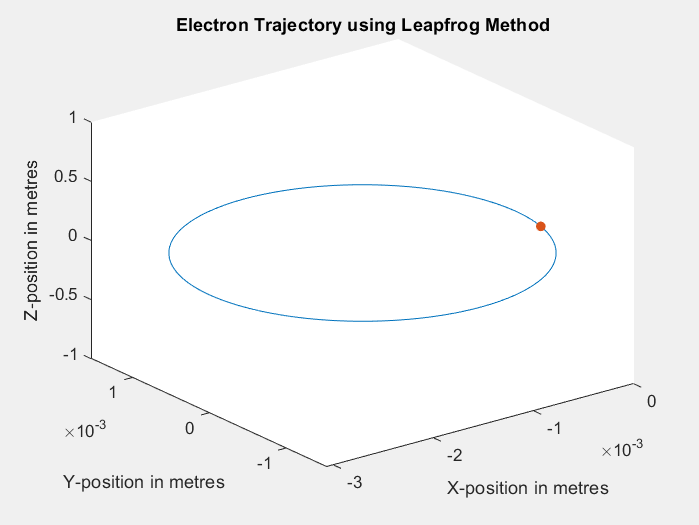
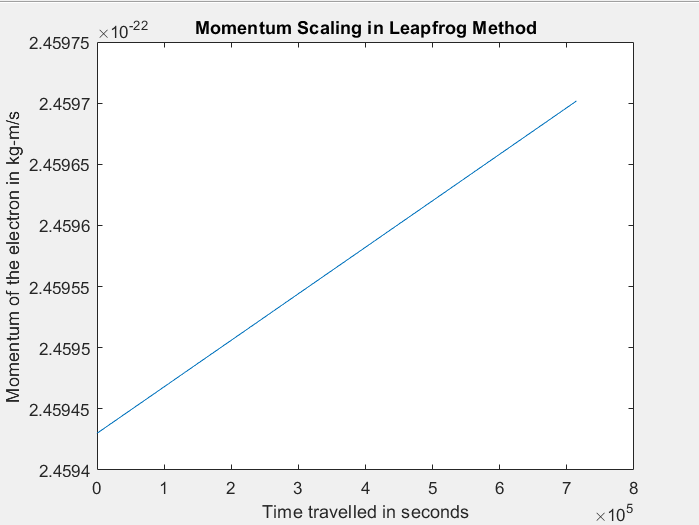
Graphs are generated automatically by running the codes.
- Hamiltonian Systems have certain global structures due to its dynamics which are prone to be missed in standard numerical integration methods. The paper by P J Channel and C Scovel in August 1988, approximates the time-delt map of the exact dynamics, which is a symplectic map. This paper can lay the basic grounds for symplectic integration in Hamiltonian Systems, and why we need them.
- The paper by G N MILSTEIN, YU. M. REPIN and M. V. TRETYAKOV implements symplectic integration methods on Hamiltonian Systems with and without noise, and checks if the symplectic structure is preserved. This is applicable in modern real world systems where measurements come with induced noise.
- The paper by Junjie Luo, Weipeng Lin and Lili Yang studies inseperable Hamiltonian Systems. Although this paper is focused on astrophysical problems, it is of interest since it uses an 8th order Runge-Kutta method, and has implemented an efficient algorithm for chaotic orbits.