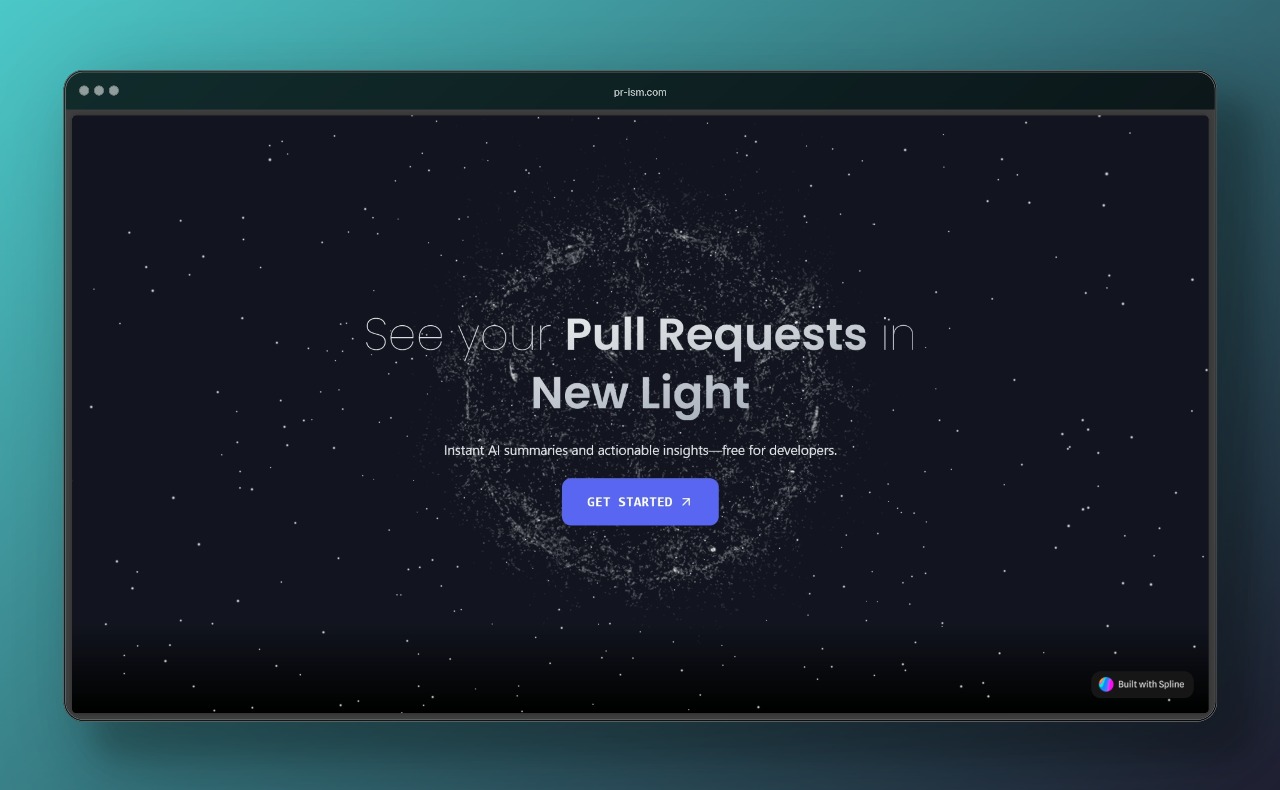
PRism is a powerful tool designed for developers, open source enthusiasts, and newcomers alike. It tracks merged pull requests (PRs) from repositories of interest and provides insightful summaries generated by a Retrieval-Augmented Generation (RAG) pipeline. By analyzing code diffs, PRism delivers detailed insights into what each PR does and why it matters, helping users quickly understand code changes, coding styles, and code quality.
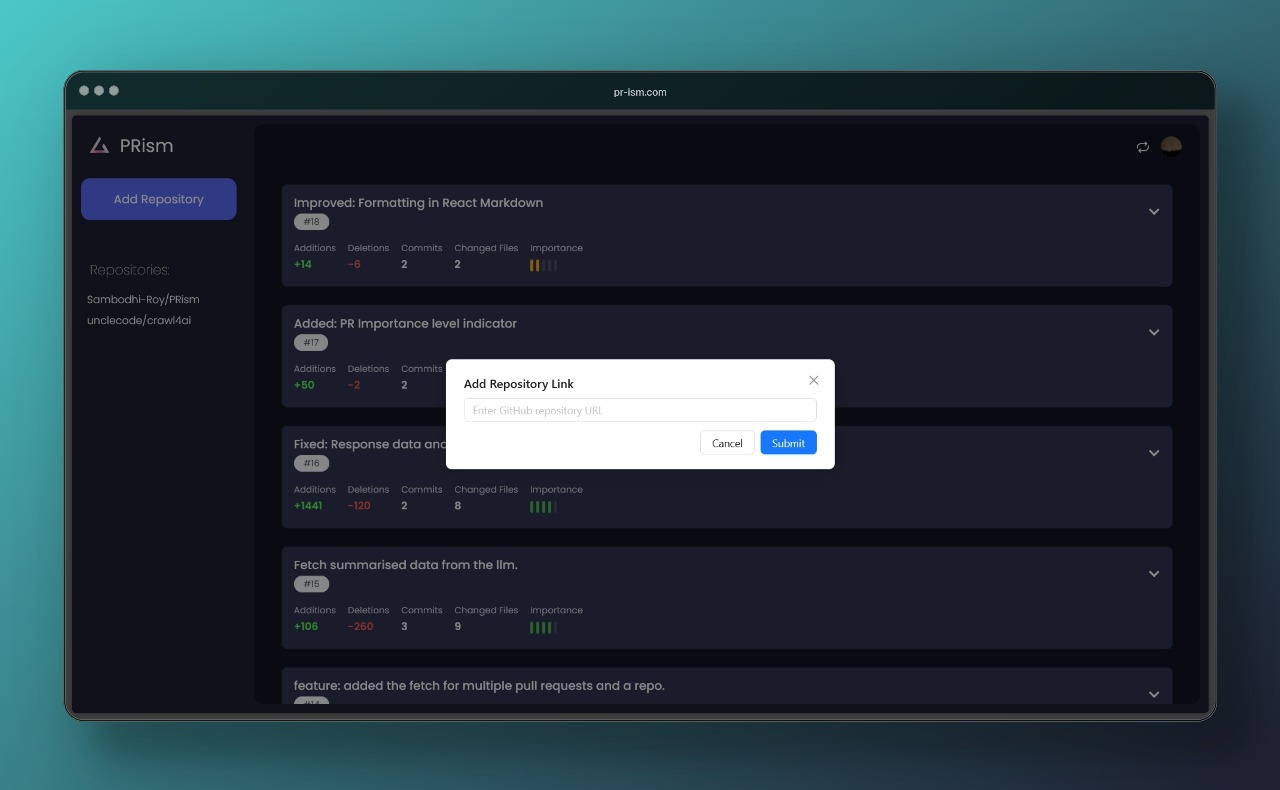
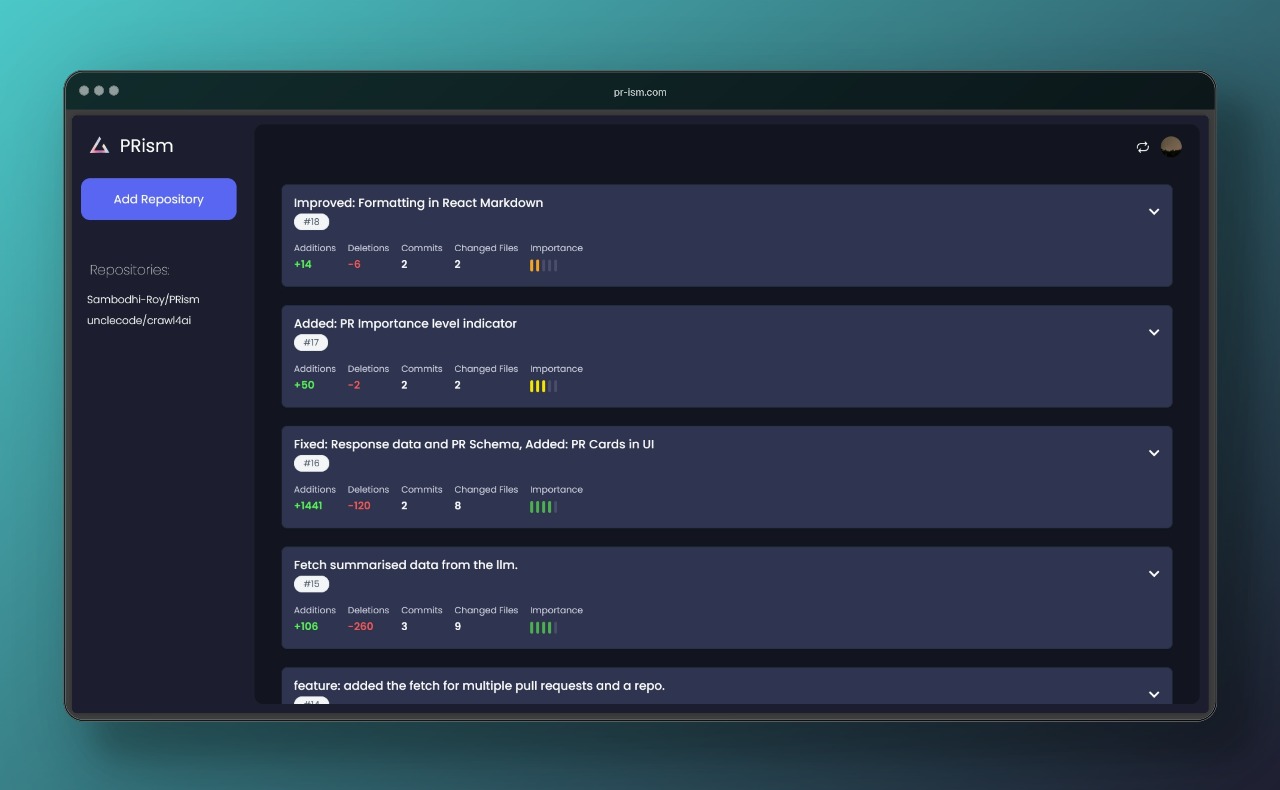
- Merged PR Tracking: Monitor and track merged PRs across your favorite repositories.
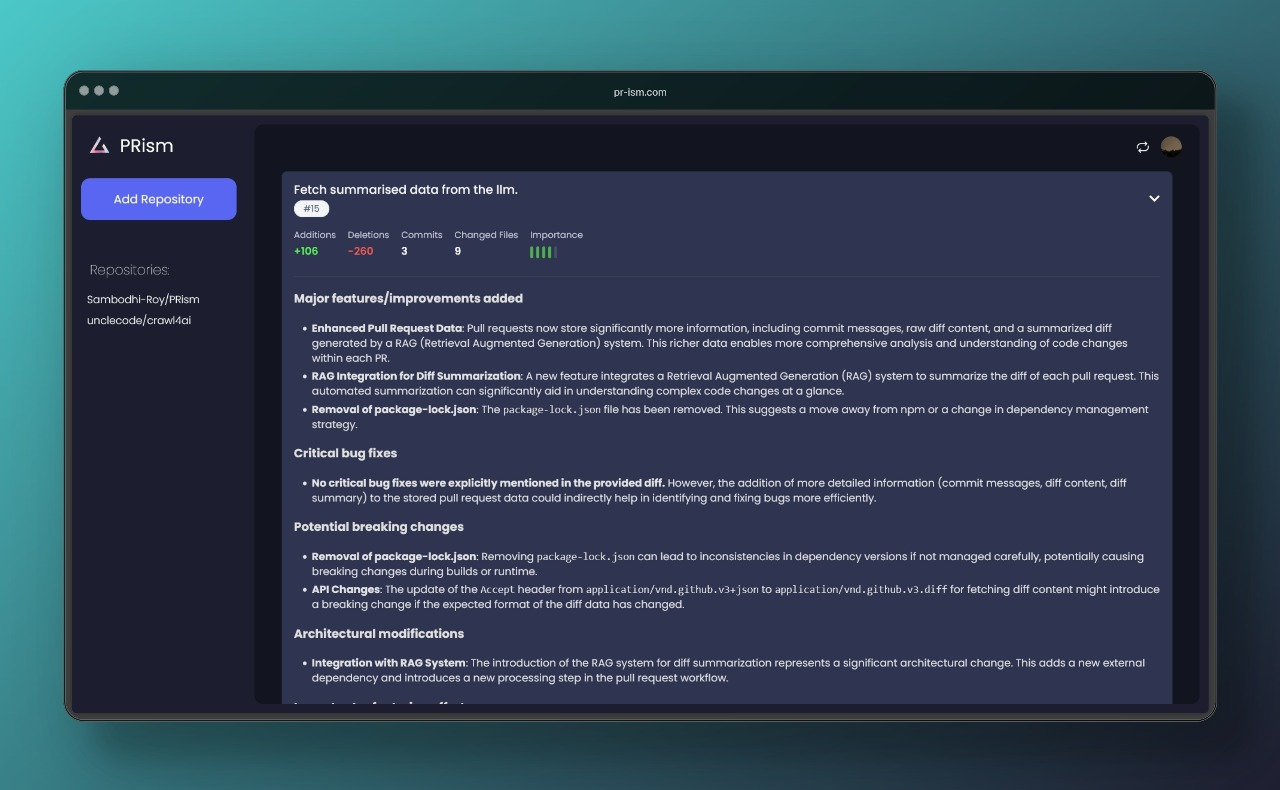
- Insightful Summaries: Automatically generated PR summaries that analyze code diffs to explain changes and their impact.
- Educational Aid: Helps newcomers learn from established coding styles and best practices used in open source projects.
- Enhanced Code Review: Assists maintainers and contributors in understanding and evaluating PRs quickly.
- Future Chat Integration: Plans to integrate a chat feature with the RAG, allowing interactive querying about repositories and specific PRs.
- Issues RAG: Upcoming functionality to generate summaries for issues, offering actionable insights and guidance.
- Frontend: React.js
- Backend: Node.js
- RAG Pipeline:
- Python
- Langchain
- FastAPI
- LLM Integration: Leveraging language models to interpret and summarize code diffs
-
Frontend (React.js):
Provides an intuitive user interface for exploring repositories, tracking PRs, and viewing summaries. -
Backend (Node.js):
Manages API requests, user authentication, and repository tracking. -
RAG Pipeline (Python, Langchain, FastAPI):
Analyzes code diffs from PRs using a Retrieval-Augmented Generation approach, generating detailed summaries and insights. -
LLM Integration:
Utilizes language models to understand the context and significance of code changes, producing human-readable summaries.
- Node.js (v14 or above)
- Python (v3.8 or above)
- Package Manager (npm or yarn for Node.js, pip for Python)
git clone https://github.com/yourusername/prism.git
cd prismNavigate to the backend directory and install dependencies:
cd backend
npm install
Start the Node.js server:
npm startNavigate to the RAG service directory and install dependencies:
cd ../llm
pip install -r requirements.txt
Start the FastAPI server:
uvicorn main:app --reloadNavigate to the frontend directory and install dependencies:
cd ../frontend
npm install
Start the React development server:
npm start-
Tracking PRs: Use the intuitive dashboard to subscribe to repositories and view tracked merged PRs.
-
Viewing Summaries: Click on any PR to see the automatically generated summary. These insights will help you understand the code changes, the reasoning behind them, and their potential impact on the project.
-
Future Interactions: Once the chat feature is implemented, you can interact with the RAG system to ask follow-up questions about specific repositories or PRs, further deepening your understanding.
We welcome contributions from developers of all levels! If you would like to contribute:
Fork the repository.
Create a new branch for your feature or bug fix.
Commit your changes with clear messages.
Open a pull request detailing your changes.
For major changes, please open an issue first to discuss what you would like to change.