A prototype information architecture and permission system for shared patient summaries in multidisciplinary clinics.
Changes made after April 6th submission:
-
Note entry tab — Added an "Add Practitioners' Notes" tab where practitioners can submit structured notes per category. Only categories their role has full access to are shown. Notes are written to a new
ConsultationandSummaryField, and the write is logged to the audit trail. -
Summary & Add Practitioners' Notes persistence - The selected practitioner persists between these two tabs such that changing the practitioner view in the Summary tab switches the view to the same practitioner in the Notes tab, and vice-versa.
-
Practitioner consent state persistence — The selected practitioner in the Practitioner Consent Settings tab now persists when switching between tabs, consistent with how the role selection persists in the Summary/Add Notes tabs.
-
Permission hierarchy fix — Reordered the checks in
filter_summaryso thatrole_restrictedis evaluated beforepatient_restricted. Previously, a patient opting out could override the reason label shown to a role that was already restricted, causing misleading feedback. -
Summary field ordering — Unified the category display order across the Summary tab and the Patient Consent Settings tab, with the three sensitive categories (Substance Use, Mental Health, Sexual Health) appearing last in both.
-
Manual note sharing behavior — Manually entered notes are treated as raw full notes and default to sharing OFF in the Practitioner Consent Settings. Toggling sharing ON replaces the note with a "Summarized practitioner notes would be shown here" placeholder, representing what an AI-generated summary would produce.
-
Audit log improvements — Audit log entries now record meaningful action labels for all event types: summary views, note submissions, and both patient and practitioner consent changes.
Backend
cd backend
python -m venv venv
source venv/bin/activate        # Windows: venv\Scripts\activate
pip install -r requirements.txt
python seed.py
uvicorn main:app --reload
Frontend
Requires Node.js >= 20. If you don't have it, download it from https://nodejs.org.
cd frontend
npm install
npm run dev
Both servers must be running for the application to work:
- Backend runs at
http://localhost:8000 - Frontend runs at
http://localhost:5173 - Interactive API docs are available at
http://localhost:8000/docs
In multidisciplinary clinics, patients see GPs, physios, dietitians, and psychologists — each keeping their own notes with no unified view. This causes:
- Missed clinical context across disciplines
- Conflicting advice given to the same patient
- Patients acting as the information bridge between practitioners
- Duplicated or unsafe care
Capsule solves this by separating structured summary facts from clinical notes. Practitioners write freely in their own notes, and a separate summary layer surfaces only what is clinically relevant to each role — with explicit visibility controls for both patients and practitioners. A practitioner can choose to make specific consultation events fully visible by toggling the summary slider off (it is on by default).
Capsule does not prevent practitioners from sharing full notes — but it makes summarised sharing the default. The AI summary extracts clinically relevant facts and removes subjective language, meaning practitioners who use the default have no reason to write defensively.
Practitioners who opt into full note sharing do so deliberately. This is a conscious tradeoff — full transparency between practitioners is sometimes clinically valuable, and Capsule doesn't prohibit it. The risk of defensive writing is managed through defaults, not restrictions.
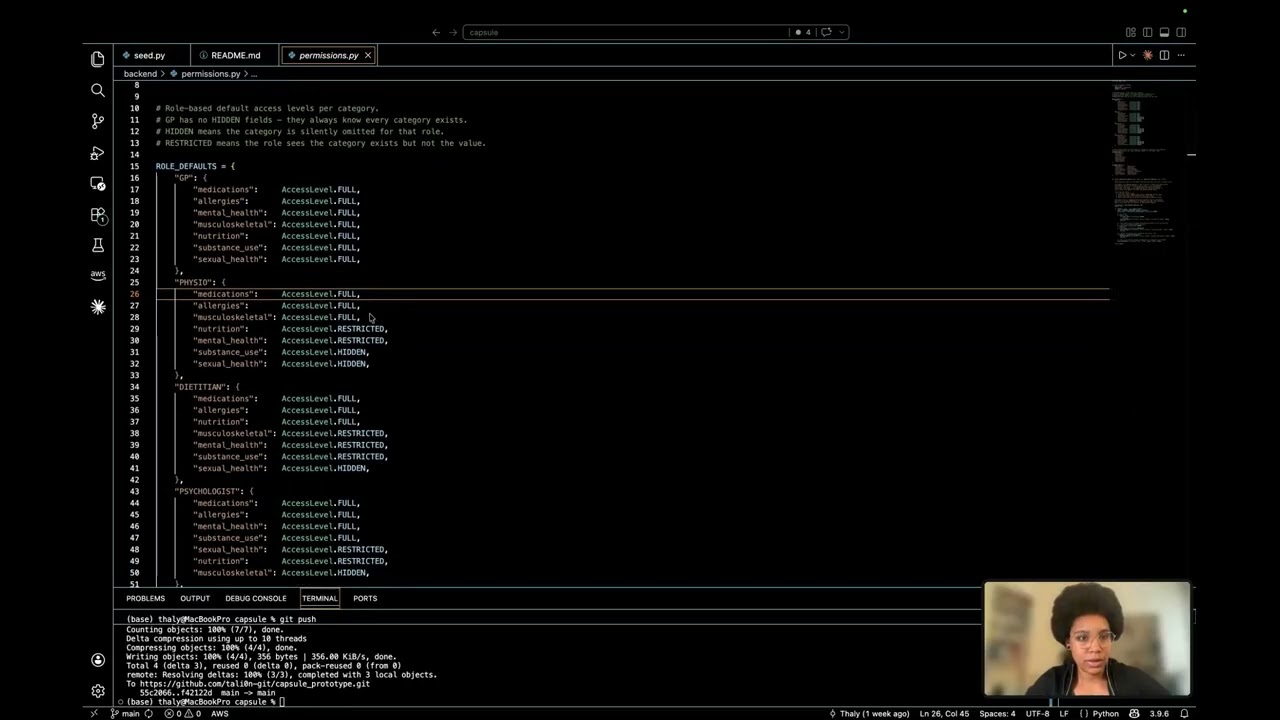
1. Role-based defaults Each discipline gets a sensible default view of patient data based on clinical relevance. All practitioners see medications and allergies. A physio also sees musculoskeletal history. A psychologist sees mental health and substance use. A dietitian sees nutritional conditions. The GP sees everything. Each practitioner recieves clear indicators when other data is unavailable and why.
2. Visibility controls Patients can opt out of sharing sensitive categories (mental health, substance use, sexual health). Practitioners can choose whether their records are summarised for colleagues and patients. Both controls are stored in the database and enforced server-side — never just hidden in the UI.
3. Audit trail Every summary access is logged with the practitioner role, patient, fields accessed, and timestamp. This protects practitioners (proves they acted on available information) and creates accountability without surveillance.
A key design decision: the GP (and subsequentially, the patient) always sees every category, even when data is unavailable. Rather than silence, every restricted field returns a reason that guides the practitioner's next action:
| Reason | What it means | Suggested action |
|---|---|---|
No record |
Nothing exists for this patient | Ask the patient directly |
Not available to your role |
Your role cannot see this category | Contact the relevant practitioner |
Patient has restricted access to this field |
Patient has opted out of sharing | Discuss with the patient directly |
- Backend: Python, FastAPI, SQLAlchemy, SQLite
- Frontend: React (Vite)
- Python 3.11+
- Node.js >= 20 (https://nodejs.org) — required for the frontend to run
The /auth/session endpoint is simulated for demo purposes. It accepts a role
(GP, PHYSIO, DIETITIAN, or PSYCHOLOGIST) and returns the first
practitioner in the database matching that role. In a production system this
would validate a JWT and return the authenticated user.
Every summary request by a practitioner is logged to the audit_logs table. To inspect it, either open the capsule.db in your IDE, or run
the following from the backend/ directory after viewing at least one summary:
sqlite3 capsule.db "SELECT * FROM audit_logs;"Each row contains: patient_id, practitioner_id, practitioner_role,
fields_accessed, and timestamp.
| Action | Value |
|---|---|
Viewing Summary tab |
["Summary", "viewed"] |
Submitting notes |
["Add Practitioners' Notes", "submitted"] |
Patient toggling consent on |
["Patient Consent Settings", "opted_in"] |
Patient toggling consent off |
["Patient Consent Settings", "opted_out"] |
Practitioner toggling consent on |
["Practitioner Consent Settings", "opted_in"] |
Practitioner toggling consent off |
["Practitioner Consent Settings", "opted_out"] |
capsule/
├── backend/
│   ├── main.py           # FastAPI entry point, registers routers, sets up CORS
│   ├── models.py         # SQLAlchemy table definitions and Pydantic schemas
│   ├── database.py       # SQLite engine, session management, get_db dependency
│   ├── seed.py           # Seeds two realistic patients
│   ├── permissions.py    # Core permission logic — roles, access levels, filter_summary
│   └── routers/
│       ├── summary.py    # Summary endpoint — filters data, writes audit log
│       ├── auth.py       # Simulated auth — accepts role, returns mock session
│       ├── consent.py    # Patient consent endpoints — GET/PATCH opted-out categories
│       └── notes.py      # Note submission endpoint — creates consultations and summary fields

└── frontend/
    ├── src/
    │   ├── components/
    │   │   ├── SummaryView.jsx      # Composes full summary from SensitiveField components
    │   │   ├── RoleSwitcher.jsx     # Demo dropdown to switch between practitioner roles
    │   │   └── SensitiveField.jsx   # Renders a single field across all visibility states
    │   └── pages/
    │       ├── PatientSummary.jsx                  # Role-filtered summary view, fetches from API
    │       ├── PractitionerConsultationsPage.jsx   # Note entry form for the active practitioner
    │       ├── PractitionerVisibilityPage.jsx      # Toggles per-consultation sharing for each practitioner
    │       └── PatientConsentPage.jsx              # Toggles patient opt-out for sensitive categories
    ├── package.json
    └── index.html
- Auth is simulated — no real JWT validation or user management
- Two patients seeded — the demo is designed around two patients: one, to illustrate the full range of visibility states across all roles, the other to show a more sparse summary example
- SQLite is used for simplicity — a production system would use PostgreSQL with row-level security
- Summary fields are static strings — a production system would generate these dynamically using Heidi to summarise structured records
-
Test addition of redacted sensitive patient info; it should be possible for a specific practitioner to have this info in their specialty's summary view (e.g. if a patient gives access to one PHYSIO, every PHYSIO will be able to see this info)
- Is this a reasonable permission format/structure to have? SHOULD every practitioner in a specific specialty be able to see one patent's sensitive info?
-
Add sliders to Practitioners' Notes, such that every note's 'voice' can be tailored depending on the specific consultation
- Make 'Goldilocks' the default