Note: This is the first time I've taught/organized this topic. It's a work in progress!
- Welcome
- Background
- What do I want to learn?/am interested in? What questions do I have?
- Rhapsodomancy is an ancient form of divination performed by choosing through some method a specific passage or poem from which to ascertain information
- Cleromancy is a form of casting of lots, in which an outcome is determined by means that normally would be considered random, such as the rolling of dice, but are sometimes believed to reveal the will of God, or other supernatural entities.
- Sortes was used by the Romans. They draw lots (aka sortes) to obtain knowledge of future events: in many of the ancient Italian temples the will of the gods was consulted in this way. Made from little tablets or counters, and were commonly thrown into a sitella or urn, filled with water, sometimes thrown like dice.
- Various words were written upon the lots such as names or poetry verse. These chosen verses were believed to cast information about the person consulting.
- In the Biblical account of the prophet Jonah, he is thrown into the sea and swallowed by the whale after the sailors on the ship cast lots to determine the guilty one who had brought about the storm.
- It was also the practice to consult the poets in the same way as Muslims do the Koran and Hafiz, and many Christians the Bible, namely, by opening the book at random and applying the first passage that struck the eye to a person's own immediate circumstances. This practice was very common among the early Christians, who substituted the Bible and the Psalter for Homer and Virgil. Many church councils repeatedly condemned these Sortes Sanctorum (sacred lots), as they were called. -Wikipedia
- I Ching - How To Consult The I Ching Oracle
- Urim and Thummim - Words referenced in the Torah referencing divination. According to classical rabbinical literature, in order for the Urim and Thummim to give an answer, it was first necessary for the individual to stand facing the fully dressed high priest, and vocalise the question briefly and in a simple way, though it wasn't necessary for it to be loud enough for anyone else to hear it.
- Urim and Thummim in Mormonism - Used to receive divine inspiration
- Ritual
- The act of touching
- ambience
- On John Cage - "When consulting the I Ching in this conventional way it needs to be interpreted but when consulting it as a chance operation it is simply giving a number – the text isn't used – and that number already has a prefigured function, such as time, position, which tool, how many lines, etc. There is no thinking or choosing to do. When Cage first began doing his chance operations he was throwing nickels or quarters even on short subway journeys, simply to generate a large number of hexagrams from which the piece would be built. Later he employed an assistant to make the coin throws, and got visitors to help, but eventually he progressed to a computer program created for him by Ed Kobrin." -source
- According To The Laws Of Chance by Jean Arp
- [Torn Woodcut](Arp felt that he could incorporate chance within artistic production, comparing the role of the artist to a plant bearing fruit. According to the Laws of Chance shows Arp playing with random composition, in this case dropping painted pieces of paper onto a surface. Torn Woodcut was made in a similar way in 1954, using the pieces of a Dada print he had made in 1920.) by Jean Arp
- Constellation
- Fluxus grew out of a book called An Anthology of Chance Operations, edited by LaMonte Young. Download (35 megabytes!) here.
- John Cage Williams Mix
- Casey Reas on chance operations
- Tristan Tzara - making a dadaist poem
- Andre Breton - Consequences game
- Surrealist Exquisite Corpse Game
- Music of Changes by John Cage
- William Burroughs and Bryan Gysin and the cut-up technique
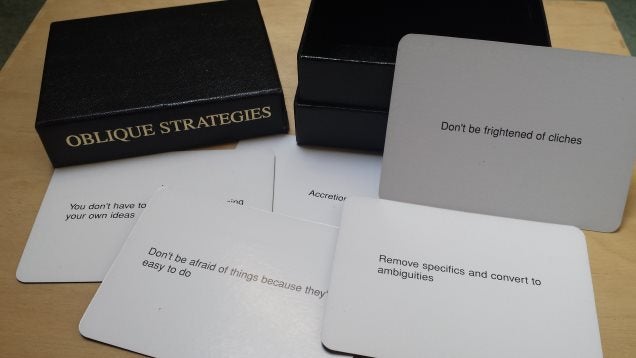
- Oblique Strategies card deck
- MASH
- Cootie Catcher and step-by-step instructions on Mom's Minivan!
- Oblique strategies website by Brian Eno and Peter Schmidt
- Fortune program by Ken Arnold.
brew install fortune - Techno Tarot by Kara Stone
- Rasputin Consulting Agency by Simon Wiscombe
- fortune by Zach Gage
- TempleOS!!!! by Terry Davis. More info on Temple OS.
- Python cootie-catcher
- Python 8-ball
- Shell scripting Fortune and Oblique Strategies mashup
- NodeJS version of fortune
- P5JS fortune starter code
- Jot down notes in a notebook. What are you inspired by? What are you going to make? How will you make it? Think about the ambience, the ritual, what questions are asked? How is info/fortune presented? Think about: How do you pull your user into metaphysical/spiritual space?
- RITUAL. What is the ritual your user/particpant will follow? Sketch this as a flow chart. What is the order of procedure for your code? (You can write this in pseudocode)
- How will your program be interactive? What will your program look like?
- Begin coding the separate parts. Start with the functions (and maybe libraries you need.
- Build and test your software and playtest it yourself and with friends. 6 Think about extending your work with a makey-makey so there is a physical interface.