| title | Code-Based Mechanical Design | |||||||
|---|---|---|---|---|---|---|---|---|
| description | Master programmatic CAD with CadQuery. Generate parametric hardware libraries, involute gears, optimized heat sinks, lattice structures, and FEA-driven designs entirely from Python code | |||||||
| pubDate | 2026-03-04 | |||||||
| tags |
|
|||||||
| excerpt | Design mechanical parts through code, not clicks. Build parametric hardware from engineering standards, generate involute gears, optimize heat sinks, create lattice structures for additive manufacturing, and drive FEA optimization loops, all from Python with CadQuery. | |||||||
| heroImage | https://cdn.siliconwit.com/education/code-based-mechanical-design/code-based-mechanical-design.png |
import Copyright from '../../../../components/Copyright.astro'; import TawkWidget from '../../../../components/TawkWidget.astro'; import { Card, CardGrid, Badge, Steps } from '@astrojs/starlight/components';
Design production-quality mechanical parts entirely from Python code using CadQuery. This self-contained course covers fastener libraries, involute gears, thermal optimization, lattice structures, spring verification, and FEA-driven design, with every lesson producing manufacturable STEP and STL output. #CadQuery #CodeBasedCAD #MechanicalDesign
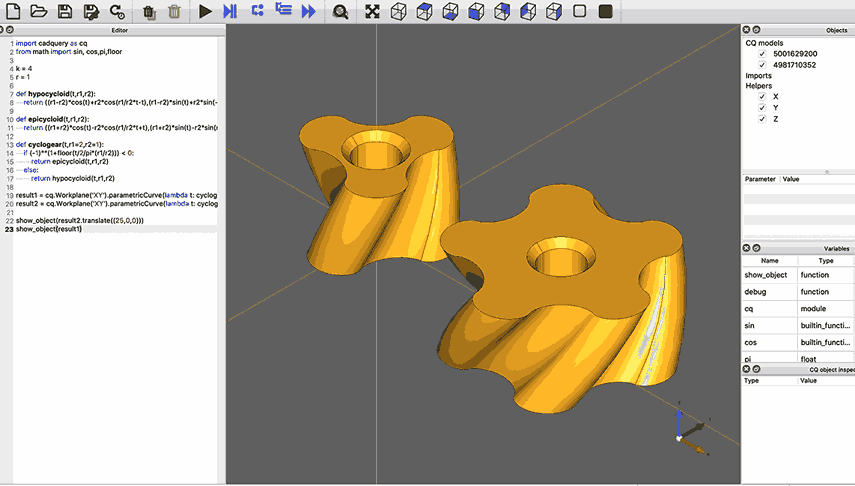
CadQuery is a Python library, not a GUI application with a scripting layer bolted on. Your CAD models are Python programs: testable, diffable, and automatable. Every dimension is a variable. Change one parameter and the entire model regenerates correctly. No manual constraint repair, no broken sketches. Direct access to NumPy, SciPy, matplotlib, pandas. Run thermal calculations, parse data files, optimize parameters, and generate geometry, all in one script. Export STEP files for CNC machining, STL for 3D printing, DXF for laser cutting. Industry-standard formats, no vendor lock-in.Each lesson follows a consistent approach:
1. **Engineering Problem** Start with a real design challenge (a hardware library, a gear system, a thermal problem), not abstract exercises.-
Theory & Standards Cover the engineering fundamentals: ISO standards, involute mathematics, thermal resistance models, stress equations.
-
CadQuery Implementation Write Python code that translates engineering knowledge into 3D geometry. Every function is parametric and reusable.
-
Verification & Output Validate designs against engineering criteria and export production-ready files.
You should be comfortable with:
- Python fundamentals (functions, loops, dictionaries)
- Basic command-line usage (pip install, running scripts)
- Engineering drawings and 3D concepts
Helpful but not required:
- Experience with FreeCAD or any CAD software
- Familiarity with NumPy/matplotlib
- Our Parametric Mechanical CAD with FreeCAD course
-
Start with Lesson 0: Code-Based CAD in Action. It walks you through 8 short scripts that produce colorful 3D models you can view in SiliconWit's GLB Viewer. By the end you will have a working environment and a feel for what code-based CAD can do.
-
Move to Lesson 1, which adds Jupyter and OCP CAD Viewer for interactive development, then builds a reusable parts library from ISO standards.
-
Work through lessons sequentially, as each builds on patterns from earlier lessons.
-
Modify parameters and experiment: the whole point of code-based design is easy iteration.
-
Export and manufacture: every lesson produces STEP/STL files ready for production.
:::tip[Coming from FreeCAD?] If you completed our Parametric Mechanical CAD with FreeCAD course, you already understand parametric thinking and engineering-first design. This course takes that mindset and applies it through code, giving you the ability to handle complexity, optimization, and automation that GUI workflows cannot match. :::