
Solana-native invoice + escrow protocol. Freelancers create invoices, international clients fund them with USDC, milestones release on client approval, and unresponsive clients trigger an automatic timeout-based release.
Live on devnet:
- Program:
DYkNRoH7goicxXzttxEALr6eRGp5EMkRxxpHQGYt3pAQ(v0.1.0 with off-ramp payout stub) - Config PDA:
A1fy8dwFrrS8U1jgiYzA7DtEbEYtvgP5AzqY9wNwaYek - Treasury USDC ATA:
P5hH8Ru8WwRkPy2rvxXzDRQpVGkedaDvU2RkPcpVjAe - Frontend: invoiceflow-five-jet.vercel.app
Verified end-to-end on devnet — first completed invoice B1ibhBzF…RQ86 — three txs, status Completed:
- create → 2. fund → 3. approve + release
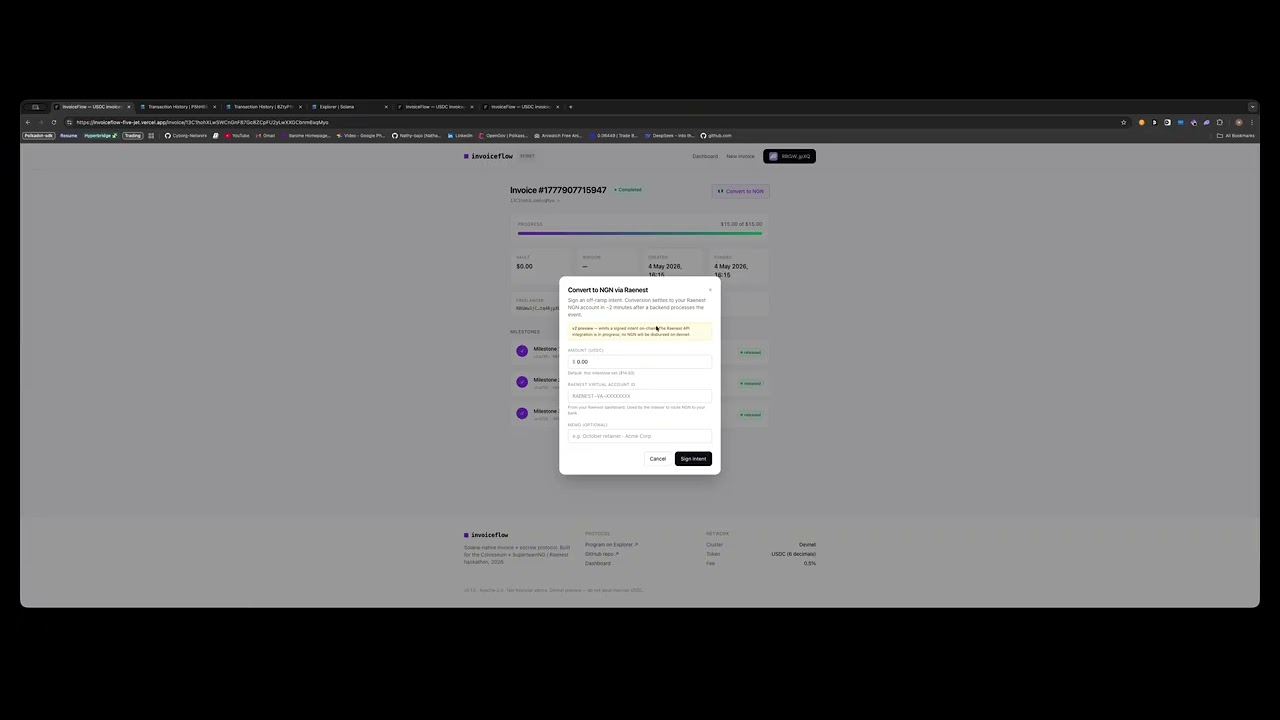
4 minutes — freelancer creates an invoice in USDC, client funds in one click, three milestones approve out, freelancer triggers the v2 off-ramp intent on-chain.
freelancer creates invoice  ──►  client funds in USDC  ──►  client approves milestone  ──►  freelancer's wallet
                                          │                          │
                                          ▼                          ▼
                                  vault PDA holds USDC       0.5% protocol fee → treasury
                                          │
                                          └─► after dispute window, anyone can permissionless-release
| Problem | How InvoiceFlow handles it | |
|---|---|---|
| 1 | Custodial freeze risk. Stripe / PayPal / Wise routinely freeze Nigerian freelancer accounts, holding weeks of income. | Vault is a Solana PDA — no human can freeze it. Not us, not the off-ramp partner, not anyone. |
| 2 | Trust gaps in both directions. Freelancer ships first or client pays first; either side can be burned. | Milestones release on client approval. Auto-release fires after a configurable timeout if the client ghosts. |
| 3 | High fees + slow settlement. Cards: 4–8%. Wires: $25 + 3 days. P2P USDT: grey-market and unauditable. | 0.5% protocol fee, <5s settlement, every release on Solana Explorer. |
Freelancer can: create up to 5 milestones in one tx · lock the invoice to a specific client wallet, or leave it open · share a URL the client opens to fund · receive USDC directly to their wallet on each approval · attach an off-chain metadata URI (Arweave / IPFS) so clients can verify each milestone's description against its on-chain sha256 · force-release a milestone if the client goes silent past the dispute window · cancel an unfunded invoice and recover the SOL rent · submit a signed off-ramp intent on-chain (v2 stub).
Client can: fund the full invoice in one click · approve milestones one at a time with fee preview · raise a dispute that pauses auto-release · resolve their own dispute when work is fixed · trust an optional third-party arbiter (set by the freelancer at create time) to adjudicate genuine disputes by splitting the vault between the two parties.
Protocol guarantees: vault is owned by the invoice PDA, no admin backdoor · fee can never exceed 10% — even the deployer can't set predatory fees · dispute window is bounded between 1 hour and 90 days · all arithmetic is checked, with the fee multiplication widened to 128-bit before narrowing.
| Stripe / PayPal | Upwork / Fiverr | Wire transfer | InvoiceFlow | |
|---|---|---|---|---|
| Account freeze risk in Nigeria | High | Medium (platform freezes) | Low | None — vault is on-chain |
| Total fee | 4–8% | 8–20% | $25 + FX | 0.5% |
| Settlement | 3–7 days | 5–14 days | 3–5 days | <5 seconds |
| Milestone escrow | No | Yes | No | Yes (on-chain) |
| Auto-release if client ghosts | No | After 14 days, contested | No | Yes, configurable |
| Counterparty trust required | High | Low (platform mediates) | High | None — code mediates |
- Rust 1.75+ · Solana CLI 1.18+ · Anchor 0.31.1 · Node 20+
sh -c "$(curl -sSfL https://release.anza.xyz/stable/install)"                # Solana
cargo install --git https://github.com/coral-xyz/anchor avm --tag v0.31.1 --locked
avm install 0.31.1 && avm use 0.31.1 # Anchorgit clone <this-repo> invoiceflow && cd invoiceflow
anchor keys sync # writes your local program keypair into lib.rs / Anchor.toml
anchor build # produces target/deploy/invoiceflow.so + IDL
npm install
anchor test # spins up a local validator, deploys, runs the test suitesolana airdrop 5 # fund deploy wallet (faucet.solana.com)
anchor deploy --provider.cluster devnet # ~3 SOL
anchor idl init -f target/idl/invoiceflow.json \
$(solana address -k target/deploy/invoiceflow-keypair.json) \
--provider.cluster devnet # publish IDL on-chain
ANCHOR_PROVIDER_URL=https://api.devnet.solana.com \
ANCHOR_WALLET=$HOME/.config/solana/id.json \
npx tsx scripts/init-protocol.ts \
--cluster devnet \
--treasury <YOUR_TREASURY_PUBKEY> \
--fee-bps 50# Get devnet USDC into your wallet from https://spl-token-faucet.com
# (mint: 4zMMC9srt5Ri5X14GAgXhaHii3GnPAEERYPJgZJDncDU)
ANCHOR_PROVIDER_URL=https://api.devnet.solana.com \
ANCHOR_WALLET=$HOME/.config/solana/id.json \
npx tsx scripts/smoke-devnet.ts
# → creates a fresh client wallet, funds it, runs create+fund+approve, prints
# the invoice URL on Solana Explorer.cd app
cp .env.example .env.local # adjust if not on devnet
npm install
npm run sync-idl # copies IDL + types from ../target/{idl,types}
npm run dev # → http://localhost:3000The app needs Phantom or Solflare and some devnet USDC (same faucet as above).
cd app
npm run sync-idl
vercel --prod
In the Vercel dashboard set these env vars (Production + Preview):
NEXT_PUBLIC_CLUSTER=devnetNEXT_PUBLIC_RPC_ENDPOINT=https://api.devnet.solana.com(browser RPC; or your private RPC)NEXT_PUBLIC_PROGRAM_ID=DYkNRoH7goicxXzttxEALr6eRGp5EMkRxxpHQGYt3pAQSOLANA_RPC_URL=https://api.devnet.solana.com(server-side RPC for the indexer cache; private Helius URL recommended at scale)HELIUS_WEBHOOK_SECRET=<long-random-string>(shared secret used to authenticate the indexer webhook below)
The dashboard works out of the box with a 60-second server cache fronting direct chain reads — fine for low traffic. For mainnet-shaped traffic, swap in a persistent Postgres-backed indexer fed by Helius webhooks:
-
Provision a Postgres database. Any provider works; the cheapest paths are:
- Neon (free tier, ~30s signup): https://neon.tech → create project → copy the
postgres://...connection string with?sslmode=require - Vercel Postgres: dashboard → Storage → Create Database → Postgres → free tier covers up to 60 hours of compute/month
- Supabase, Railway, or any self-hosted Postgres also work — the driver is plain
postgres
- Neon (free tier, ~30s signup): https://neon.tech → create project → copy the
-
Set
DATABASE_URLin the Vercel project (Production + Preview env vars), and locally inapp/.env.localfor development. -
Run migrations + backfill once:
DATABASE_URL='postgres://...' npm run migrate:indexer
DATABASE_URL='postgres://...' SOLANA_RPC_URL=https://api.devnet.solana.com \
  npm run backfill:indexer
Migration creates the
invoicestable + indexes; backfill scans the deployed program and upserts every existing invoice. Both are idempotent — safe to re-run after schema changes or program redeploys. -
Point a Helius webhook at the app for real-time updates:
- Create an account at https://helius.dev and grab an API key.
- Webhooks → Create webhook:
- Webhook URL:
https://<your-vercel>.vercel.app/api/webhook - Authentication header: paste your
HELIUS_WEBHOOK_SECRETvalue - Transaction type:
ANY - Account addresses:
DYkNRoH7goicxXzttxEALr6eRGp5EMkRxxpHQGYt3pAQ(the program) - Webhook type:
Enhanced
- Webhook URL:
On every program-touching tx Helius now POSTs to
/api/webhook. The handler walks the tx'saccountData[], fetches each account's current state in one batched RPC call, decodes any that are Invoices, and upserts into Postgres — so the dashboard reflects the change in ~1–3 seconds.
Why off-ramps are a partnership layer, not part of InvoiceFlow. InvoiceFlow doesn't move money to or from bank accounts — we don't hold reserves, don't have banking licences, don't want to. We're the contract layer that makes "client in NYC pays freelancer in Lagos" go from a 5-day Stripe-or-Wise dance into one-click escrow → approve → off-ramp. Off-ramp providers already have the bank relationships, the regulatory licences, and the local-currency liquidity. The freelancer sees one product; under the hood it's two complementary fees: ours for the contract leg, the off-ramp's for the settlement leg.
v2 — off-chain wiring (on-chain handshake already shipped):
- ✅ Off-ramp payout instruction +
RaenestPayoutRequestedevent are live on devnet. The "Cash out" button on the invoice page submits a signed intent. - 🔜 Off-chain bridge: subscribe to program logs and call an off-ramp provider's USDC→local-currency settlement API. Pluggable per provider.
- ✅ Helius-webhook indexer feeding a Postgres cache for the dashboard — shipped (see v3 row).
v3 — protocol features:
- ✅ Helius-webhook indexer + persistent Postgres cache replacing the dashboard's direct
getProgramAccountsscans — shipped. Defaults to a 60s server cache whenDATABASE_URLis unset; flips to DB-backed indexing when configured (see deploy section). - ✅ Optional third-party arbiter for genuine disputes — shipped, see the
arbiterfield oncreate_invoiceand the newarbiter_resolveinstruction. - ✅ Invoice metadata URI (Arweave / IPFS) on top of the on-chain description hash, see
metadata_urifield oncreate_invoiceand the verified-description badges on the invoice page. - Mainnet deploy after security audit (Sec3 / OtterSec).
Apache-2.0